In recent years, Inspire Investing and our coalition partners have worked extensively with financial institutions to address risks related to viewpoint based financial exclusion. In 2025, these efforts resulted in favorable engagement outcomes with several major institutions, including JPMorgan Chase, Bank of America, Citigroup, Regions, PNC, and Western Alliance. These engagements produced constructive dialogue and policy clarifications aimed at promoting clearer and more consistently applied account access standards.
As detailed in our 2025 report, Advancing Civil Liberties: Inspire’s De-Banking Engagement Successes and the New Executive Order, these results are built on years of sustained shareholder engagement across the financial sector.
Inspire has been confronting these issues long before they became headline topics. For several years, we have led shareholder engagement with financial institutions on de-banking risks, filing resolutions, submitting Notices of Exempt Solicitation, and working directly with executive teams to strengthen policies that protect civil liberties, viewpoint diversity, and fair access to financial services.
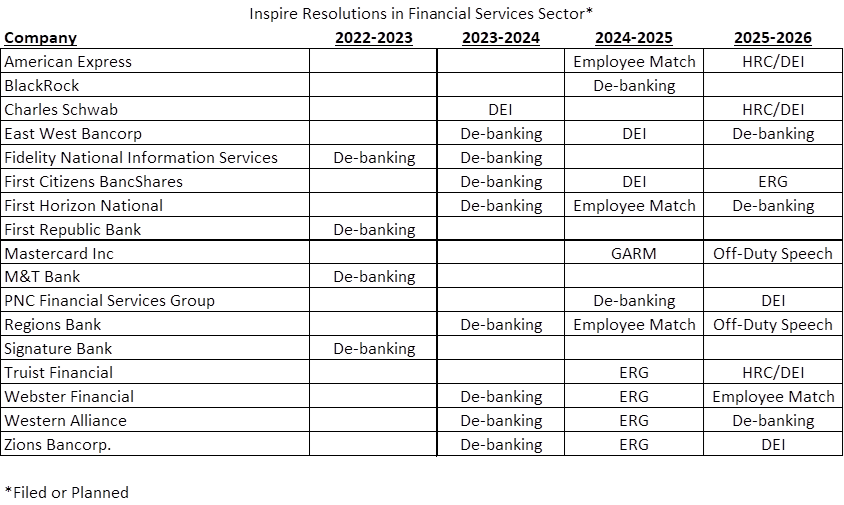
Those results serve as a tangible example of how sustained shareholder engagement can influence corporate policies and risk frameworks. As the broader landscape has evolved through regulatory action, litigation, and policy discussions, the experience of the past year illustrates a broader lesson about how company level engagement can contribute to wider industry and societal change.
The environment surrounding de-banking has continued to evolve. An August 2025 Executive Order reinforced expectations that banks apply policies in a viewpoint neutral manner, and a January 2026 lawsuit filed by President Donald Trump against JPMorgan Chase seeking approximately $5 billion dollars in damages further elevated public attention on account access practices. JPMorgan has denied the claims and the case remains in early stages.
Regulators including the Federal Reserve, FDIC, and OCC have taken steps to reduce reliance on reputational risk as a supervisory factor, while policymakers in Congress continue exploring bipartisan proposals aimed at establishing clearer national standards for fair access to financial services. As noted in our prior report, Senator Elizabeth Warren expressed interest in working with Senator Tim Scott and the Administration on these issues, underscoring the wide nature of the concern.
More recently, reports indicate that the Office of the Comptroller of the Currency (OCC) is nearing completion of a broad review of alleged politically or religiously motivated de-banking practices at several major financial institutions, a review that reportedly encompasses approximately 100,000 customer complaints. In addition, the U.S. Department of Justice has reportedly issued subpoenas to several large financial institutions as part of an investigation into alleged de-banking practices. While these matters remain ongoing and no conclusions have been reached, they further illustrate how concerns regarding fair access to financial services have continued to gain attention from regulators and policymakers, reinforcing the broader shift described throughout this report.
These broader legal and regulatory developments did not fundamentally change our approach for this engagement season, but they did accelerate the conversations. Many of the risks highlighted by policymakers and regulators were the same issues we had been raising with companies for years through sustained engagement.
As the conversation has matured, engagement this year has often been more straightforward. There is growing recognition that access to basic financial services is a matter of fundamental fairness, and discussions increasingly focus on policy clarity and risk management rather than debating first principles.
This alignment helped create a more constructive environment in which firms were often willing to address concerns proactively, allowing progress to occur through dialogue rather than formal shareholder proposals.

Inspire engaged with Truist to continue dialogue from the prior year regarding language in its online and mobile banking service agreement and related policies governing customer conduct and account access. During this engagement, the company provided updated wording reflecting revisions it had made to its service agreement language. These updates aligned with feedback Inspire and other coalition partners had previously provided and reflected the company’s broader review of policies in light of evolving regulatory expectations.
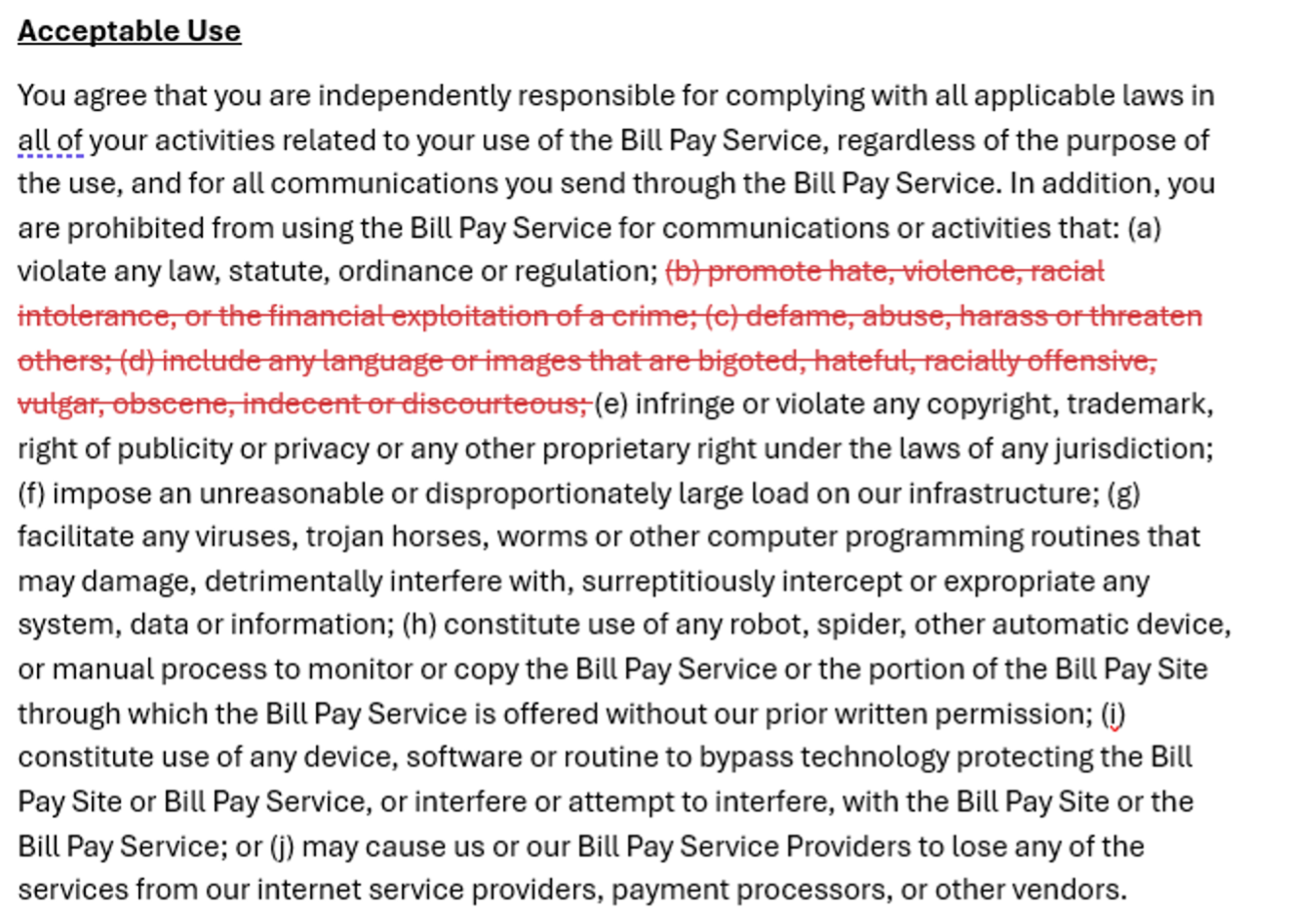
In addition to these policy updates, Truist clarified that it is not a sponsor or partner of the Human Rights Campaign (HRC) and discussed related cultural and governance topics with us, including gender transition care for minors. We expect dialogue on those topics to continue.
Based on these changes and the responsiveness of the Truist team throughout the engagement process, Inspire withdrew its shareholder proposal and continues to view the company as a constructive partner on these issues.
Inspire engaged with First Horizon on risks related to viewpoint based financial exclusion and clarity in customer facing policies. Early in the process in late 2025, the company updated language in its Human Rights Statement, reflecting responsiveness to concerns raised during engagement.
Updated Human Rights Statement as of October 2025
“First Horizon and our subsidiaries are committed to a position of lending fairness and to making available meaningful services to all of our clients and communities on a fair and equitable basis. We do not restrict or deny products or financial services based on a client’s or potential client's religious or political beliefs or lawful activities.”
In 2026, First Horizon also initiated a review of customer account agreements and related materials to further assess opportunities for clarity around access standards and risk-based decision making. The company also confirmed it is not participating in the HRC Index.
Given the company’s early responsiveness and continued willingness to engage, Inspire determined that withdrawal of the proposal was appropriate while dialogue continues.
Inspire’s engagement with East West Bank focused on de-banking risk and the clarity of customer-facing policies, including terms of service language and acceptable use standards. Following a collaborative dialogue, the company implemented updates clarifying that its policies are grounded in applicable law, safety and soundness considerations, and legitimate business purposes rather than customers’ lawful expression or beliefs.
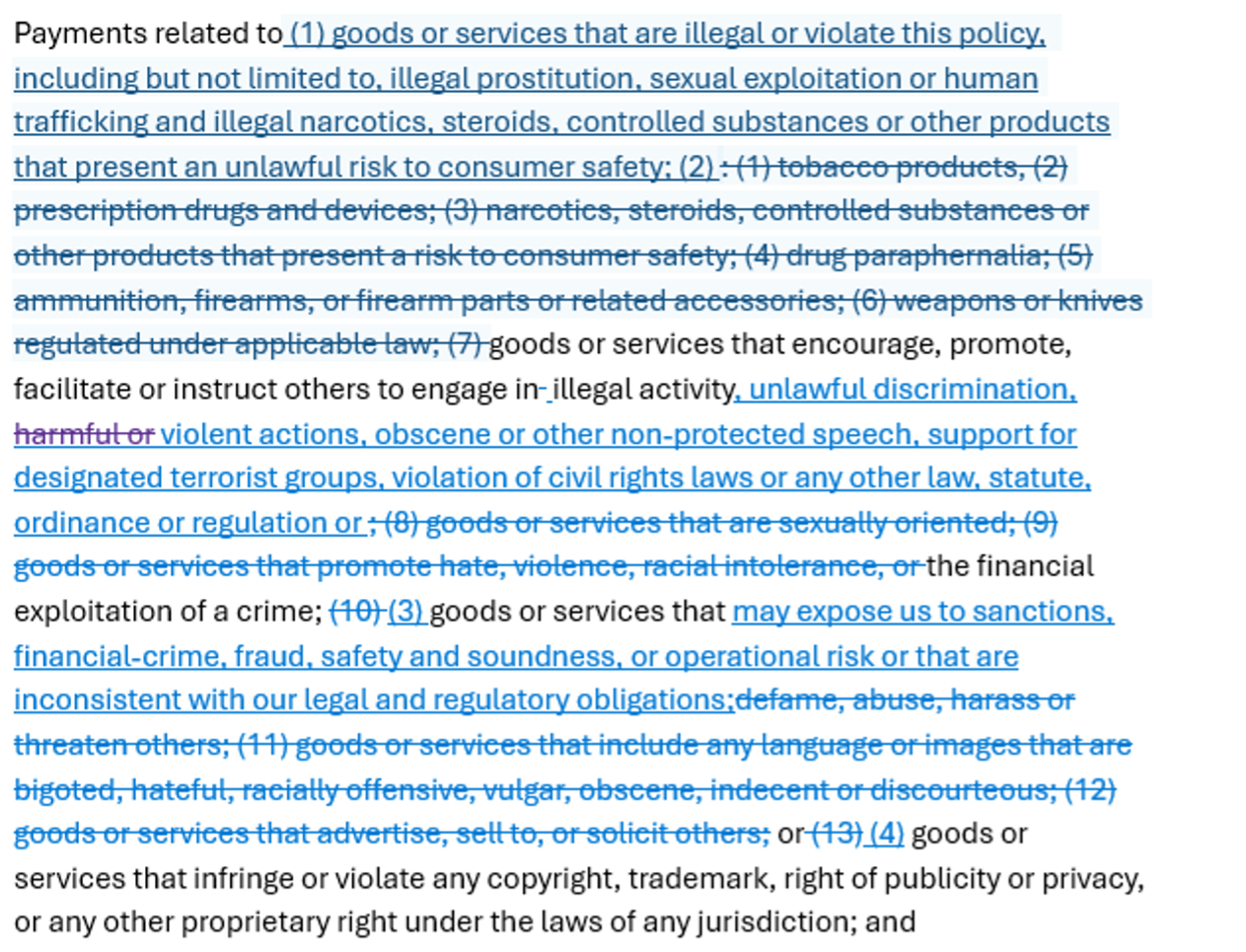
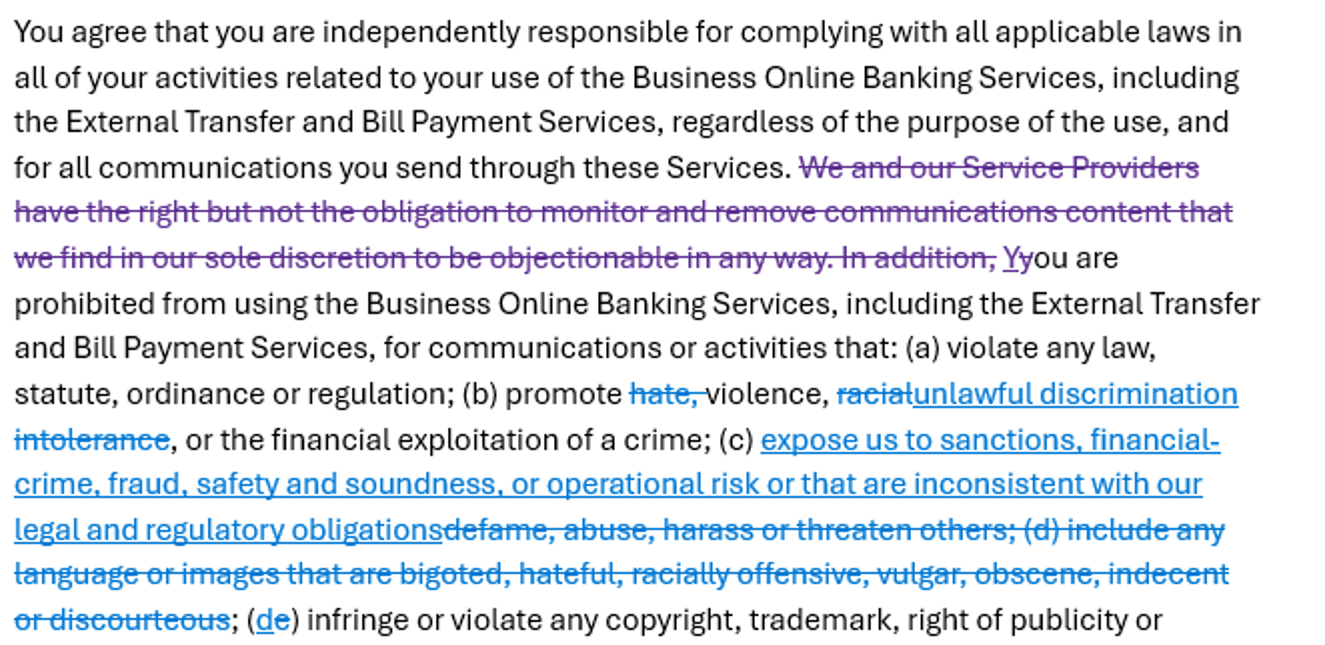
Separately, East West Bank provided transparency regarding internal governance and cultural initiatives. The company confirmed that it has ceased organizational support for previously formed employee resource groups, noting that activities under the auspices of prior ERG banners no longer occur. East West Bank also confirmed that it is not participating in the HRC Index.
Based on this highly productive engagement and resulting policy clarity, Inspire elected not to file a shareholder proposal and continues to view East West Bank as a constructive partner.
Inspire engaged with PNC regarding risks associated with viewpoint-based account access decisions and related policy language. This engagement builds on our work last year with the company, during which PNC reiterated its commitment to non-discrimination in its Corporate Responsibility Report. During the current engagement cycle, the company provided documentation and representations confirming that decisions regarding customer access to financial services are based on individualized, objective, and risk-based analyses.
The PNC team was highly responsive throughout the dialogue, providing detailed follow-up and engaging in good faith discussions. Based on these clarifications and the constructive tone of the engagement, Inspire withdrew its shareholder proposal and looks forward to continuing dialogue as regulatory expectations evolve.
Inspire has engaged with Zions for several years on issues related to customer agreements and civil liberties considerations. During the most recent engagement cycle, the company indicated that its customer agreements and related materials were undergoing review through its standard compliance change management process and that updates were likely as part of that process.
Zions also confirmed that it is not participating in the HRC Index.
Although final revisions were not available prior to the withdrawal deadline, Inspire elected to withdraw its shareholder proposal based on the anticipated updates described by the company and the longstanding constructive engagement between the parties. Inspire looks forward to continuing dialogue as the review process progresses.
Inspire engaged with Webster regarding de-banking risk and related policy clarity, including updates to its Code of Business Conduct and Ethics and internal training reinforcing fair access principles. Webster provided detailed assurances that decisions regarding customer access to services are grounded in objective, risk-based criteria and aligned with federal expectations regarding fair access to banking services. As a result of the company’s de-banking and fair access review, Webster added language to its Code of Ethics training, as follows:
“Fair Access: Webster Bank is committed to maintaining the highest standards of fairness, integrity, and regulatory compliance in all aspects of its operations. In alignment with federal regulatory expectations and Executive Order 14331 (Guaranteeing Fair Banking for All Americans), all colleagues are expected to adhere to the following principle: Webster does not restrict access to financial services based on a customer’s or potential customer’s lawful business activities for political reasons or based on their political or religious beliefs. All decisions regarding account openings and closings, loan approvals and denials, and other financial services must be made without political or religious bias. All colleagues must remain vigilant in their day-to-day responsibilities to ensure that eligibility determinations, account management, and lending decisions are based solely on objective business risk factors, including but not limited to, creditworthiness, BSA/AML risk, fraud risk, legal/regulatory risk, and operational capacity.”
The company also confirmed that it has not participated in the HRC Index. As part of this broader dialogue, Inspire had been considering filing a shareholder proposal related to employee gift matching and charitable neutrality. In response, Webster clarified that it does not maintain a standing employee matching gift program or policy. When budget permits, the company may offer limited “pop-up” grant opportunities (separate and apart from its overall strategic Corporate Philanthropic grant making), and it represented that all eligible 501(c)(3) organizations, including houses of worship that provide services to the community at large, may apply and are treated consistently. The company further noted that at least three houses of worship received employee matching grants in 2025.
In light of these representations and clarifications, we elected not to pursue that resolution this season and will continue to monitor developments in this area.
Inspire’s engagement with Western Alliance this year builds on constructive dialogue from the prior year, during which the company updated its Corporate Responsibility Report to reflect commitments related to employee development and its anti-harassment and non-discrimination policies.
Following continued discussions regarding account access policies and related disclosures, and after reviewing updated materials shared by the company, Inspire determined that continuing engagement outside the proxy process would be the most productive path forward and therefore did not submit a shareholder proposal this cycle.
Western Alliance also confirmed that it is in the process of establishing a faith-based employee resource group, an item we have encouraged at Western Alliance and other institutions. In addition, the company confirmed that it is not participating in the HRC Index. Inspire looks forward to continuing engagement as these discussions progress.
Inspire engaged with Regions regarding risks associated with viewpoint-based account access and related policy language. This engagement builds on our work last year with the company, during which Regions updated its 2024 Shared Value Report to reflect various commitments made through dialogue with Inspire. Through continued engagement, the company provided additional clarity regarding how its policies are applied and reaffirmed its commitment to fair and consistent treatment of customers.
In addition to these discussions, Inspire engaged with Regions on separate but related topics including off-duty speech protections and charitable giving policies. The company worked constructively to clarify Code of Conduct language around lawful expression and took steps to improve clarity in its giving policies regarding support for faith affiliated organizations. Regions also confirmed it is not participating in the HRC Index.
We have engaged constructively with Regions for several years and have found the company to be among the most responsive partners in our engagement program.
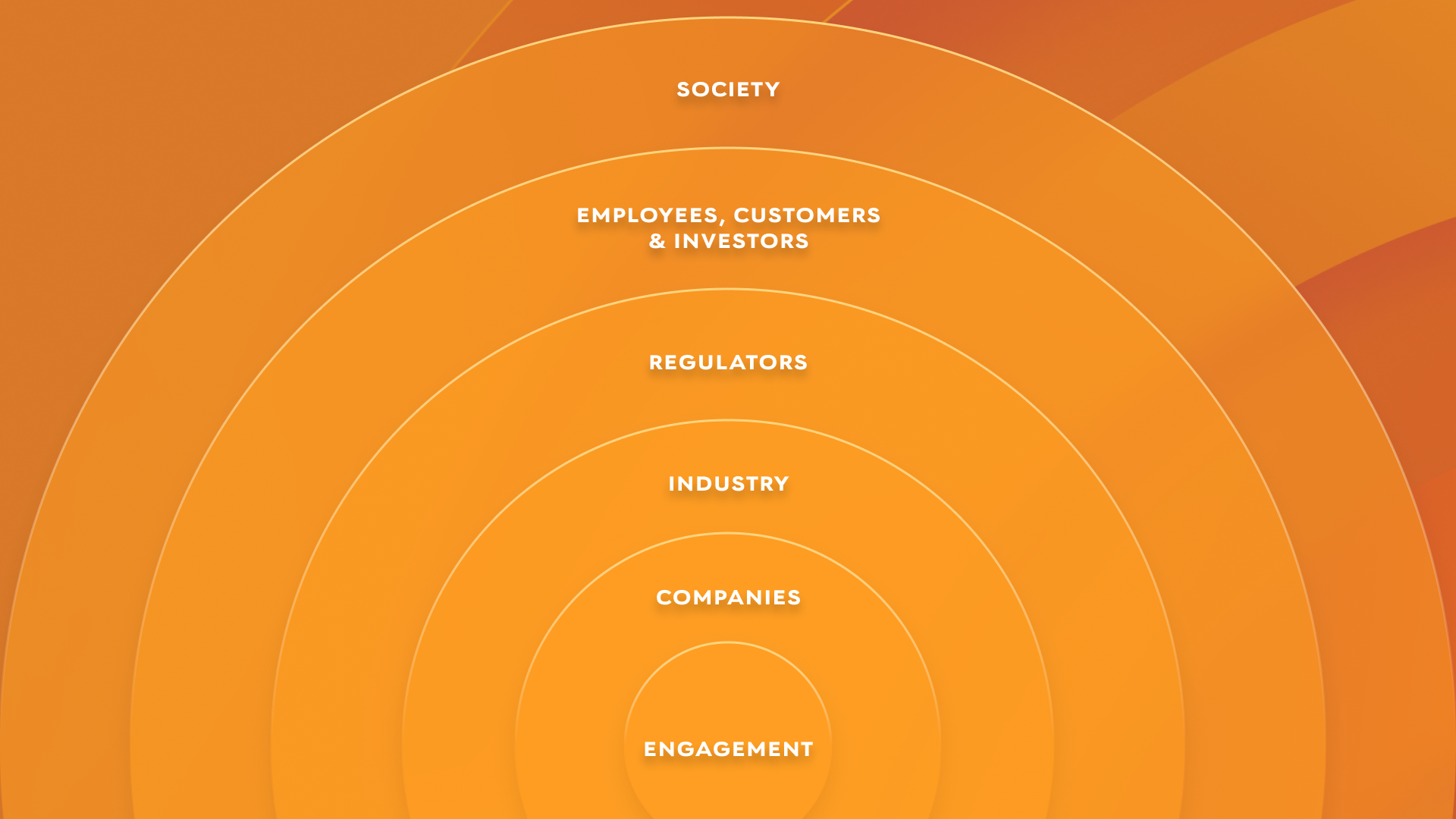
One of the clearest lessons from this work is how company level engagement can drive broader societal impact. When policies are clarified at individual institutions, those changes influence industry norms, inform regulatory thinking, and ultimately shape public expectations.
8 of the 13 largest U.S. banks have now updated policies, disclosures, or governance practices following growing scrutiny around fair access and viewpoint neutrality.
Inspire’s experience illustrates a ripple effect:
Having worked on these issues for several years, we have often found ourselves flagging risks to companies well before they become widely recognized. The recent shift in the public and policy conversation reflects how sustained engagement can help surface emerging issues early and contribute to meaningful long-term change.
Inspire remains committed to continuing this work in the years ahead, engaging constructively with companies, regulators, and stakeholders to promote clear standards, reduce emerging risks, and support fair access to financial services for all customers, regardless of their religious or political views.
We are grateful to the companies that engaged constructively and in good faith throughout this process, and to our coalition partners and advisors, including Alliance Defending Freedom and Bowyer Research, along with The Bahnsen Group for its leadership, particularly related to JPMorgan Chase.
Thoughtful dialogue and a shared commitment to clarity and fairness remain essential to advancing practical solutions that benefit customers, companies, and the broader financial system.

Tim Schwarzenberger, CFA is a Portfolio Manager and Director of Corporate Engagement for Inspire Investing. He previously served as Managing Director at Christian Brothers Investment Services (CBIS), where he was an integral member of the Investment Team responsible for implementing the firm’s strategy development, portfolio construction, and Catholic investing initiatives.


In recent years, Inspire Investing and our coalition partners have worked extensively with financial institutions to address risks related to viewpoint based financial exclusion. In 2025, these efforts resulted in favorable engagement outcomes with several major institutions, including JPMorgan Chase, Bank of America, Citigroup, Regions, PNC, and Western Alliance. These engagements produced constructive dialogue and policy clarifications aimed at promoting clearer and more consistently applied account access standards.
As detailed in our 2025 report, Advancing Civil Liberties: Inspire’s De-Banking Engagement Successes and the New Executive Order, these results are built on years of sustained shareholder engagement across the financial sector.
Inspire has been confronting these issues long before they became headline topics. For several years, we have led shareholder engagement with financial institutions on de-banking risks, filing resolutions, submitting Notices of Exempt Solicitation, and working directly with executive teams to strengthen policies that protect civil liberties, viewpoint diversity, and fair access to financial services.
Those results serve as a tangible example of how sustained shareholder engagement can influence corporate policies and risk frameworks. As the broader landscape has evolved through regulatory action, litigation, and policy discussions, the experience of the past year illustrates a broader lesson about how company level engagement can contribute to wider industry and societal change.
The environment surrounding de-banking has continued to evolve. An August 2025 Executive Order reinforced expectations that banks apply policies in a viewpoint neutral manner, and a January 2026 lawsuit filed by President Donald Trump against JPMorgan Chase seeking approximately $5 billion dollars in damages further elevated public attention on account access practices. JPMorgan has denied the claims and the case remains in early stages.
Regulators including the Federal Reserve, FDIC, and OCC have taken steps to reduce reliance on reputational risk as a supervisory factor, while policymakers in Congress continue exploring bipartisan proposals aimed at establishing clearer national standards for fair access to financial services. As noted in our prior report, Senator Elizabeth Warren expressed interest in working with Senator Tim Scott and the Administration on these issues, underscoring the wide nature of the concern.
More recently, reports indicate that the Office of the Comptroller of the Currency (OCC) is nearing completion of a broad review of alleged politically or religiously motivated de-banking practices at several major financial institutions, a review that reportedly encompasses approximately 100,000 customer complaints. In addition, the U.S. Department of Justice has reportedly issued subpoenas to several large financial institutions as part of an investigation into alleged de-banking practices. While these matters remain ongoing and no conclusions have been reached, they further illustrate how concerns regarding fair access to financial services have continued to gain attention from regulators and policymakers, reinforcing the broader shift described throughout this report.
These broader legal and regulatory developments did not fundamentally change our approach for this engagement season, but they did accelerate the conversations. Many of the risks highlighted by policymakers and regulators were the same issues we had been raising with companies for years through sustained engagement.
As the conversation has matured, engagement this year has often been more straightforward. There is growing recognition that access to basic financial services is a matter of fundamental fairness, and discussions increasingly focus on policy clarity and risk management rather than debating first principles.
This alignment helped create a more constructive environment in which firms were often willing to address concerns proactively, allowing progress to occur through dialogue rather than formal shareholder proposals.
Inspire engaged with Truist to continue dialogue from the prior year regarding language in its online and mobile banking service agreement and related policies governing customer conduct and account access. During this engagement, the company provided updated wording reflecting revisions it had made to its service agreement language. These updates aligned with feedback Inspire and other coalition partners had previously provided and reflected the company’s broader review of policies in light of evolving regulatory expectations.
In addition to these policy updates, Truist clarified that it is not a sponsor or partner of the Human Rights Campaign (HRC) and discussed related cultural and governance topics with us, including gender transition care for minors. We expect dialogue on those topics to continue.
Based on these changes and the responsiveness of the Truist team throughout the engagement process, Inspire withdrew its shareholder proposal and continues to view the company as a constructive partner on these issues.
Inspire engaged with First Horizon on risks related to viewpoint based financial exclusion and clarity in customer facing policies. Early in the process in late 2025, the company updated language in its Human Rights Statement, reflecting responsiveness to concerns raised during engagement.
Updated Human Rights Statement as of October 2025
“First Horizon and our subsidiaries are committed to a position of lending fairness and to making available meaningful services to all of our clients and communities on a fair and equitable basis. We do not restrict or deny products or financial services based on a client’s or potential client's religious or political beliefs or lawful activities.”
In 2026, First Horizon also initiated a review of customer account agreements and related materials to further assess opportunities for clarity around access standards and risk-based decision making. The company also confirmed it is not participating in the HRC Index.
Given the company’s early responsiveness and continued willingness to engage, Inspire determined that withdrawal of the proposal was appropriate while dialogue continues.
Inspire’s engagement with East West Bank focused on de-banking risk and the clarity of customer-facing policies, including terms of service language and acceptable use standards. Following a collaborative dialogue, the company implemented updates clarifying that its policies are grounded in applicable law, safety and soundness considerations, and legitimate business purposes rather than customers’ lawful expression or beliefs.
Separately, East West Bank provided transparency regarding internal governance and cultural initiatives. The company confirmed that it has ceased organizational support for previously formed employee resource groups, noting that activities under the auspices of prior ERG banners no longer occur. East West Bank also confirmed that it is not participating in the HRC Index.
Based on this highly productive engagement and resulting policy clarity, Inspire elected not to file a shareholder proposal and continues to view East West Bank as a constructive partner.
Inspire engaged with PNC regarding risks associated with viewpoint-based account access decisions and related policy language. This engagement builds on our work last year with the company, during which PNC reiterated its commitment to non-discrimination in its Corporate Responsibility Report. During the current engagement cycle, the company provided documentation and representations confirming that decisions regarding customer access to financial services are based on individualized, objective, and risk-based analyses.
The PNC team was highly responsive throughout the dialogue, providing detailed follow-up and engaging in good faith discussions. Based on these clarifications and the constructive tone of the engagement, Inspire withdrew its shareholder proposal and looks forward to continuing dialogue as regulatory expectations evolve.
Inspire has engaged with Zions for several years on issues related to customer agreements and civil liberties considerations. During the most recent engagement cycle, the company indicated that its customer agreements and related materials were undergoing review through its standard compliance change management process and that updates were likely as part of that process.
Zions also confirmed that it is not participating in the HRC Index.
Although final revisions were not available prior to the withdrawal deadline, Inspire elected to withdraw its shareholder proposal based on the anticipated updates described by the company and the longstanding constructive engagement between the parties. Inspire looks forward to continuing dialogue as the review process progresses.
Inspire engaged with Webster regarding de-banking risk and related policy clarity, including updates to its Code of Business Conduct and Ethics and internal training reinforcing fair access principles. Webster provided detailed assurances that decisions regarding customer access to services are grounded in objective, risk-based criteria and aligned with federal expectations regarding fair access to banking services. As a result of the company’s de-banking and fair access review, Webster added language to its Code of Ethics training, as follows:
“Fair Access: Webster Bank is committed to maintaining the highest standards of fairness, integrity, and regulatory compliance in all aspects of its operations. In alignment with federal regulatory expectations and Executive Order 14331 (Guaranteeing Fair Banking for All Americans), all colleagues are expected to adhere to the following principle: Webster does not restrict access to financial services based on a customer’s or potential customer’s lawful business activities for political reasons or based on their political or religious beliefs. All decisions regarding account openings and closings, loan approvals and denials, and other financial services must be made without political or religious bias. All colleagues must remain vigilant in their day-to-day responsibilities to ensure that eligibility determinations, account management, and lending decisions are based solely on objective business risk factors, including but not limited to, creditworthiness, BSA/AML risk, fraud risk, legal/regulatory risk, and operational capacity.”
The company also confirmed that it has not participated in the HRC Index. As part of this broader dialogue, Inspire had been considering filing a shareholder proposal related to employee gift matching and charitable neutrality. In response, Webster clarified that it does not maintain a standing employee matching gift program or policy. When budget permits, the company may offer limited “pop-up” grant opportunities (separate and apart from its overall strategic Corporate Philanthropic grant making), and it represented that all eligible 501(c)(3) organizations, including houses of worship that provide services to the community at large, may apply and are treated consistently. The company further noted that at least three houses of worship received employee matching grants in 2025.
In light of these representations and clarifications, we elected not to pursue that resolution this season and will continue to monitor developments in this area.
Inspire’s engagement with Western Alliance this year builds on constructive dialogue from the prior year, during which the company updated its Corporate Responsibility Report to reflect commitments related to employee development and its anti-harassment and non-discrimination policies.
Following continued discussions regarding account access policies and related disclosures, and after reviewing updated materials shared by the company, Inspire determined that continuing engagement outside the proxy process would be the most productive path forward and therefore did not submit a shareholder proposal this cycle.
Western Alliance also confirmed that it is in the process of establishing a faith-based employee resource group, an item we have encouraged at Western Alliance and other institutions. In addition, the company confirmed that it is not participating in the HRC Index. Inspire looks forward to continuing engagement as these discussions progress.
Inspire engaged with Regions regarding risks associated with viewpoint-based account access and related policy language. This engagement builds on our work last year with the company, during which Regions updated its 2024 Shared Value Report to reflect various commitments made through dialogue with Inspire. Through continued engagement, the company provided additional clarity regarding how its policies are applied and reaffirmed its commitment to fair and consistent treatment of customers.
In addition to these discussions, Inspire engaged with Regions on separate but related topics including off-duty speech protections and charitable giving policies. The company worked constructively to clarify Code of Conduct language around lawful expression and took steps to improve clarity in its giving policies regarding support for faith affiliated organizations. Regions also confirmed it is not participating in the HRC Index.
We have engaged constructively with Regions for several years and have found the company to be among the most responsive partners in our engagement program.
One of the clearest lessons from this work is how company level engagement can drive broader societal impact. When policies are clarified at individual institutions, those changes influence industry norms, inform regulatory thinking, and ultimately shape public expectations.
8 of the 13 largest U.S. banks have now updated policies, disclosures, or governance practices following growing scrutiny around fair access and viewpoint neutrality.
Inspire’s experience illustrates a ripple effect:
Having worked on these issues for several years, we have often found ourselves flagging risks to companies well before they become widely recognized. The recent shift in the public and policy conversation reflects how sustained engagement can help surface emerging issues early and contribute to meaningful long-term change.
Inspire remains committed to continuing this work in the years ahead, engaging constructively with companies, regulators, and stakeholders to promote clear standards, reduce emerging risks, and support fair access to financial services for all customers, regardless of their religious or political views.
We are grateful to the companies that engaged constructively and in good faith throughout this process, and to our coalition partners and advisors, including Alliance Defending Freedom and Bowyer Research, along with The Bahnsen Group for its leadership, particularly related to JPMorgan Chase.
Thoughtful dialogue and a shared commitment to clarity and fairness remain essential to advancing practical solutions that benefit customers, companies, and the broader financial system.



.jpg)