Microsoft's recent policy change highlights a broader shift as companies strengthen employee choice, charitable neutrality, and reevaluate the role of the Southern Poverty Law Center (SPLC) and other third-party influences in workplace giving.
Every year, millions of employees participate in workplace gift-matching programs, directing billions of dollars to charitable organizations across the country. Yet few employees, and perhaps even many companies, fully understand how those programs determine which charities are eligible to receive matching gifts.
In early July, as part of Inspire’s engagement with Microsoft this year, the company confirmed to Inspire Investing that it had removed the Southern Poverty Law Center (SPLC) filter from its Benevity employee gift-matching platform in late 2025. The same topic had also been the subject of engagement by Inspire’s corporate engagement partners last year. Based on Microsoft’s confirmation, Inspire withdrew its shareholder proposal.
Microsoft's decision is significant, but it also reflects a broader trend that has been quietly unfolding across corporate America.
For years, Inspire Investing and our coalition partners have engaged public companies on employee gift matching, charitable neutrality, and the treatment of religious organizations in workplace giving. Our objective has been straightforward: to encourage companies to administer employee gift-matching programs using objective, transparent, and viewpoint-neutral standards that empower employees to support lawful charitable organizations consistent with their own convictions.
Our request to companies has been remarkably simple. If an organization qualifies as a lawful IRS-recognized 501(c)(3) public charity and otherwise satisfies a company's charitable giving policies, employees should not lose matching benefits because of additional ideological classifications imposed by outside advocacy organizations.
Employee gift-matching programs are among the most appreciated workplace benefits offered by corporate America. Approximately two-thirds of Fortune 500 companies offer matching gift programs, allowing employees to amplify the impact of their charitable giving.
These programs exist for one purpose: to encourage generosity by allowing employees to support the charitable organizations they value.
Research cited in Inspire's Microsoft shareholder proposal found that 97% of employees want flexibility in how and where they give, while employer-imposed restrictions discourage charitable participation. Religious organizations also remain the largest category of charitable recipients in the United States.
Yet during years of shareholder engagement, we discovered that many companies outsource administration of these programs to third-party providers. In many cases, companies may not fully understand how charities are screened or what eligibility criteria are being applied behind the scenes.
• Benevity
• Deed
• CyberGrants
• YourCause (Blackbaud)
• Bright Funds
One organization surfaced repeatedly during our engagements: the Southern Poverty Law Center.
According to research conducted by Inspire Investing and our coalition partners, just over 20% of Fortune 1000 companies use Benevity to administer employee gift-matching programs. Those companies represent trillions in market capitalization and employ several million people.
The earliest evidence we have found of Benevity referencing the SPLC dates back to its 2021 Goodness Matters conference, where then-CEO Kelly Schmitt highlighted the use of the SPLC's 'hate list' as part of its charity vetting process. Although Benevity has disputed relying on the SPLC, our direct engagements with public companies have confirmed that an SPLC-based filter has existed within the platform and that companies have the ability to disable it.
Our concern has never been whether companies should prevent donations to unlawful organizations or genuinely violent extremist groups. Rather, our concern is that companies should not rely on ideological classifications created by outside advocacy organizations to determine whether employees may support otherwise lawful charities.
The SPLC has become a prominent example of why this issue matters. Originally founded as a public interest law firm that later became well known for litigation against organizations such as the Ku Klux Klan, the SPLC has expanded its “Hate Map” over the years to include numerous mainstream religious and conservative organizations, including Alliance Defending Freedom, Family Research Council, American Family Association, and Turning Point USA.
More recently, the SPLC has become the subject of significant legal scrutiny. A federal indictment alleges that the SPLC engaged in bank fraud by concealing millions of dollars in payments from donors and financial institutions. The indictment also alleges that the organization accepted funding from groups it publicly portrayed as part of the extremist movements it claimed to oppose. Regardless of the ultimate outcome of those proceedings, the situation illustrates a broader governance lesson. Companies should be cautious about outsourcing charitable eligibility decisions to outside advocacy organizations whose methodologies, governance, or legal standing may later become the subject of controversy, congressional scrutiny, or legal investigation.
To be clear, Inspire is not asking companies to match donations to every organization. Companies should continue to ensure that participating charities are lawful IRS-recognized 501(c)(3) organizations. Our request is much narrower: companies should remove additional ideological screening requirements, such as SPLC-based filters, for otherwise eligible 501(c)(3) organizations. Microsoft demonstrated exactly how companies can accomplish this.
The table below provides a high-level summary of recent engagement outcomes. Additional context and details for each company are provided in the sections that follow.

Years of constructive shareholder engagement have produced meaningful progress across corporate America. Not every engagement resulted in the same type of outcome. Some companies changed policies, some disabled third-party filters, and others provided important clarity regarding existing practices. Taken together, these outcomes show that companies are increasingly willing to review employee gift-matching programs through the lens of charitable neutrality and employee choice.
Microsoft became the latest company to demonstrate that employee gift-matching programs can be strengthened through constructive shareholder engagement.
Inspire filed a shareholder proposal asking Microsoft to evaluate the risks associated with excluding religious organizations from its employee gift-matching program and the use of third-party ideological screening. During engagement, Microsoft confirmed that it had removed the SPLC filter from its Benevity platform in late 2025. As a result, otherwise eligible IRS-recognized 501(c)(3) organizations are no longer subject to that additional ideological screening within Microsoft's employee gift-matching program.
Based on information Microsoft provided, Inspire withdrew its shareholder proposal. Microsoft's decision demonstrates that companies using third-party platforms such as Benevity can review these settings and make thoughtful changes that strengthen employee choice while maintaining appropriate safeguards for charitable giving.
In late 2025, Inspire Investing filed a shareholder resolution with McDonald's addressing risks related to charitable partnerships and employee benefits, including employee gift-matching programs, third-party advocacy organizations, and healthcare coverage for minors.
Following the filing, Inspire met with members of McDonald's company leadership on three occasions in January 2026. Discussions focused on McDonald's use of Benevity for employee gift matching, its involvement with the Human Rights Campaign, and its framework for evaluating healthcare benefits in light of evolving legal and regulatory considerations.
The engagement was constructive. McDonald's confirmed that it does not use Benevity's SPLC filter and reiterated that it continues to pause participation in all external surveys, such as the Human Rights Campaign's Corporate Equality Index. The company also agreed to share its high-level framework for evaluating health care coverage design against various factors, such as applicable legal requirements. Based on these commitments, Inspire withdrew its shareholder proposal.
As part of a broader shareholder engagement, Inspire filed a shareholder proposal with Delta Air Lines addressing corporate neutrality and related governance issues. During the engagement, Delta indicated that its charitable and donation-matching programs are limited to educational institutions but remain inclusive of religiously affiliated organizations, helping ensure employees can support causes aligned with their beliefs. Delta also confirmed that it does not use Benevity to administer its employee gift-matching program. Based on these commitments, and others, Inspire withdrew its shareholder proposal.
We especially appreciated Delta's thoughtful and constructive engagement throughout this process. The dialogue was candid, solution-oriented, and focused on ensuring that employees retain the ability to support lawful charitable organizations consistent with their convictions.
During shareholder engagement, Schwab confirmed that religious organizations are eligible for matching gifts under its employee gift-matching program and are not excluded from participation, providing helpful clarity regarding the company's existing policy.
This was not presented as a policy change. Rather, it provided important confirmation that Schwab's existing employee gift-matching program allows religious organizations to participate, consistent with the broader principle of charitable neutrality.
Inspire engaged Mastercard regarding employee charitable giving, charitable neutrality, and the use of third-party screening criteria in workplace giving programs. These issues were also the subject of a separate shareholder proposal filed by The Heritage Foundation.
Following those discussions, Mastercard confirmed that it removed the SPLC filter from its employee gift-matching program. This outcome helped ensure that otherwise eligible charities are not excluded because of an additional ideological classification imposed by an outside advocacy organization.
Mastercard's action reinforces the broader point that companies using third-party giving platforms can review and adjust their settings to better align employee giving programs with objective eligibility standards and employee choice.
During discussions with NVIDIA, Inspire raised employee charitable giving, viewpoint neutrality, and the use of third-party screening criteria within employee giving platforms. These issues were also the subject of a separate shareholder proposal filed by the Oklahoma TSET.
NVIDIA confirmed that the SPLC filter had been disabled within its employee giving platform. This confirmation helped address concerns that lawful charitable organizations could be excluded from employee giving based on outside ideological classifications.
The outcome also underscores that these platform settings can be reviewed and adjusted without eliminating ordinary safeguards for charitable eligibility.
Employee gift matching and charitable neutrality were among the topics discussed during Inspire's engagement with American Express. These issues were also the subject of a separate shareholder proposal filed by The Heritage Foundation.
American Express confirmed that the SPLC filter was no longer active within its employee gift-matching program. This provided important assurance that the company was not relying on that additional ideological screen to determine charitable eligibility.
As with other companies, the engagement helped focus attention on employee choice, objective charitable standards, and the need for companies to understand the screening criteria embedded in third-party giving platforms.
Inspire discussed employee gift matching and third-party charitable screening during its broader shareholder engagement with Halliburton.
Halliburton indicated that it is reassessing its employee gift-matching program and the systems that support it, with plans to focus matching gifts on higher education. The company also confirmed that qualified religiously affiliated educational institutions remain eligible for matching gifts.
Halliburton's approach illustrates another path companies may take: rather than focusing solely on a specific filter, companies can reassess their broader administration model for employee charitable giving.
In response, Webster clarified that it does not maintain a standing employee matching gift program or policy. When budget permits, the company may offer limited pop-up grant opportunities that are separate from its overall strategic corporate philanthropic grantmaking. Webster represented that all eligible 501(c)(3) organizations, including houses of worship that provide services to the community at large, may apply and are treated consistently.
The company further noted that at least three houses of worship received employee matching grants in 2025. Based on these representations and clarifications, Inspire elected not to pursue a shareholder proposal. Webster's engagement is a useful example of how constructive dialogue can provide transparency even when a company does not maintain a standard employee gift-matching program.
Following those discussions, Regions revised its Community Engagement guidelines by removing its previous exclusion of organizations whose primary purpose is to serve as a place of worship. The updated guidelines no longer categorically exclude religious organizations, instead applying objective eligibility standards when evaluating charitable giving requests.
These changes reflect Regions' willingness to thoughtfully evaluate concerns raised during shareholder engagement and strengthen its approach to charitable neutrality.
Inspire's work represents only part of a much broader coalition effort. Our coalition partners have also secured meaningful improvements at numerous public companies, including Salesforce, Texas Instruments, Bank of America, Verizon, Philip Morris, Wells Fargo, DoorDash, Citi, and others.
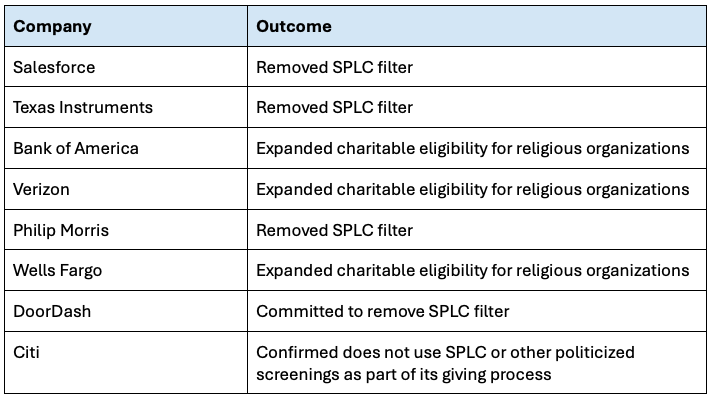
These companies have removed SPLC-based screening, expanded employee access to religious organizations, or otherwise strengthened employee choice within workplace giving programs.
Viewed individually, these policy changes may seem incremental. Viewed collectively, they represent one of the most significant shifts in employee gift matching across corporate America in recent years.
More companies are recognizing that employee gift-matching programs should be governed by objective standards established by the company itself, rather than additional ideological classifications supplied by outside advocacy organizations.
We want to thank the many companies that engaged thoughtfully and constructively throughout this process. While not every engagement resulted in the same outcome, we appreciate the willingness of Microsoft, McDonald's, Delta Air Lines, Charles Schwab, Mastercard, NVIDIA, American Express, Halliburton, Webster Financial, Regions Financial, and many others to listen, ask questions, and thoughtfully evaluate their employee gift-matching programs.
Constructive shareholder engagement works best when companies and investors approach these conversations with mutual respect and a shared commitment to long-term value creation. We believe these engagements demonstrate that meaningful progress is possible through respectful dialogue and collaboration.
We also want to thank our coalition partners for their collaboration throughout these engagements. We are especially grateful to Alliance Defending Freedom, Bowyer Research, 1792 Exchange, and The Heritage Foundation for their leadership, expertise, and tireless work advancing employee choice and charitable neutrality across corporate America.
Based on our research, more than 200 Fortune 1000 companies continue to use Benevity to administer employee gift-matching programs.
Microsoft's recent decision demonstrates that these settings are not permanent. Companies can review them, understand them, and improve them.
Inspire Investing and our coalition partners intend to continue engaging companies to encourage employee gift-matching programs that are transparent, viewpoint neutral, and respectful of employees' charitable choices.
Our objective remains simple. If a charity is a lawful IRS-recognized 501(c)(3) organization and otherwise meets a company's charitable giving policies, employees should be free to direct their matching gifts to that organization without additional ideological screening imposed by outside advocacy organizations.
We believe Microsoft's recent decision provides a constructive model for corporate America. We are encouraged by the growing number of companies strengthening employee gift matching and look forward to continuing this work in the years ahead.
The Daily Signal Exclusive: https://www.dailysignal.com/2026/07/22/microsoft-stops-discriminating-against-conservatives/

Tim Schwarzenberger, CFA is a Portfolio Manager and Director of Corporate Engagement for Inspire Investing. He previously served as Managing Director at Christian Brothers Investment Services (CBIS), where he was an integral member of the Investment Team responsible for implementing the firm’s strategy development, portfolio construction, and Catholic investing initiatives.


Microsoft's recent policy change highlights a broader shift as companies strengthen employee choice, charitable neutrality, and reevaluate the role of the Southern Poverty Law Center (SPLC) and other third-party influences in workplace giving.
Every year, millions of employees participate in workplace gift-matching programs, directing billions of dollars to charitable organizations across the country. Yet few employees, and perhaps even many companies, fully understand how those programs determine which charities are eligible to receive matching gifts.
In early July, as part of Inspire’s engagement with Microsoft this year, the company confirmed to Inspire Investing that it had removed the Southern Poverty Law Center (SPLC) filter from its Benevity employee gift-matching platform in late 2025. The same topic had also been the subject of engagement by Inspire’s corporate engagement partners last year. Based on Microsoft’s confirmation, Inspire withdrew its shareholder proposal.
Microsoft's decision is significant, but it also reflects a broader trend that has been quietly unfolding across corporate America.
For years, Inspire Investing and our coalition partners have engaged public companies on employee gift matching, charitable neutrality, and the treatment of religious organizations in workplace giving. Our objective has been straightforward: to encourage companies to administer employee gift-matching programs using objective, transparent, and viewpoint-neutral standards that empower employees to support lawful charitable organizations consistent with their own convictions.
Our request to companies has been remarkably simple. If an organization qualifies as a lawful IRS-recognized 501(c)(3) public charity and otherwise satisfies a company's charitable giving policies, employees should not lose matching benefits because of additional ideological classifications imposed by outside advocacy organizations.
Employee gift-matching programs are among the most appreciated workplace benefits offered by corporate America. Approximately two-thirds of Fortune 500 companies offer matching gift programs, allowing employees to amplify the impact of their charitable giving.
These programs exist for one purpose: to encourage generosity by allowing employees to support the charitable organizations they value.
Research cited in Inspire's Microsoft shareholder proposal found that 97% of employees want flexibility in how and where they give, while employer-imposed restrictions discourage charitable participation. Religious organizations also remain the largest category of charitable recipients in the United States.
Yet during years of shareholder engagement, we discovered that many companies outsource administration of these programs to third-party providers. In many cases, companies may not fully understand how charities are screened or what eligibility criteria are being applied behind the scenes.
• Benevity
• Deed
• CyberGrants
• YourCause (Blackbaud)
• Bright Funds
One organization surfaced repeatedly during our engagements: the Southern Poverty Law Center.
According to research conducted by Inspire Investing and our coalition partners, just over 20% of Fortune 1000 companies use Benevity to administer employee gift-matching programs. Those companies represent trillions in market capitalization and employ several million people.
The earliest evidence we have found of Benevity referencing the SPLC dates back to its 2021 Goodness Matters conference, where then-CEO Kelly Schmitt highlighted the use of the SPLC's 'hate list' as part of its charity vetting process. Although Benevity has disputed relying on the SPLC, our direct engagements with public companies have confirmed that an SPLC-based filter has existed within the platform and that companies have the ability to disable it.
Our concern has never been whether companies should prevent donations to unlawful organizations or genuinely violent extremist groups. Rather, our concern is that companies should not rely on ideological classifications created by outside advocacy organizations to determine whether employees may support otherwise lawful charities.
The SPLC has become a prominent example of why this issue matters. Originally founded as a public interest law firm that later became well known for litigation against organizations such as the Ku Klux Klan, the SPLC has expanded its “Hate Map” over the years to include numerous mainstream religious and conservative organizations, including Alliance Defending Freedom, Family Research Council, American Family Association, and Turning Point USA.
More recently, the SPLC has become the subject of significant legal scrutiny. A federal indictment alleges that the SPLC engaged in bank fraud by concealing millions of dollars in payments from donors and financial institutions. The indictment also alleges that the organization accepted funding from groups it publicly portrayed as part of the extremist movements it claimed to oppose. Regardless of the ultimate outcome of those proceedings, the situation illustrates a broader governance lesson. Companies should be cautious about outsourcing charitable eligibility decisions to outside advocacy organizations whose methodologies, governance, or legal standing may later become the subject of controversy, congressional scrutiny, or legal investigation.
To be clear, Inspire is not asking companies to match donations to every organization. Companies should continue to ensure that participating charities are lawful IRS-recognized 501(c)(3) organizations. Our request is much narrower: companies should remove additional ideological screening requirements, such as SPLC-based filters, for otherwise eligible 501(c)(3) organizations. Microsoft demonstrated exactly how companies can accomplish this.
The table below provides a high-level summary of recent engagement outcomes. Additional context and details for each company are provided in the sections that follow.
Years of constructive shareholder engagement have produced meaningful progress across corporate America. Not every engagement resulted in the same type of outcome. Some companies changed policies, some disabled third-party filters, and others provided important clarity regarding existing practices. Taken together, these outcomes show that companies are increasingly willing to review employee gift-matching programs through the lens of charitable neutrality and employee choice.
Microsoft became the latest company to demonstrate that employee gift-matching programs can be strengthened through constructive shareholder engagement.
Inspire filed a shareholder proposal asking Microsoft to evaluate the risks associated with excluding religious organizations from its employee gift-matching program and the use of third-party ideological screening. During engagement, Microsoft confirmed that it had removed the SPLC filter from its Benevity platform in late 2025. As a result, otherwise eligible IRS-recognized 501(c)(3) organizations are no longer subject to that additional ideological screening within Microsoft's employee gift-matching program.
Based on information Microsoft provided, Inspire withdrew its shareholder proposal. Microsoft's decision demonstrates that companies using third-party platforms such as Benevity can review these settings and make thoughtful changes that strengthen employee choice while maintaining appropriate safeguards for charitable giving.
In late 2025, Inspire Investing filed a shareholder resolution with McDonald's addressing risks related to charitable partnerships and employee benefits, including employee gift-matching programs, third-party advocacy organizations, and healthcare coverage for minors.
Following the filing, Inspire met with members of McDonald's company leadership on three occasions in January 2026. Discussions focused on McDonald's use of Benevity for employee gift matching, its involvement with the Human Rights Campaign, and its framework for evaluating healthcare benefits in light of evolving legal and regulatory considerations.
The engagement was constructive. McDonald's confirmed that it does not use Benevity's SPLC filter and reiterated that it continues to pause participation in all external surveys, such as the Human Rights Campaign's Corporate Equality Index. The company also agreed to share its high-level framework for evaluating health care coverage design against various factors, such as applicable legal requirements. Based on these commitments, Inspire withdrew its shareholder proposal.
As part of a broader shareholder engagement, Inspire filed a shareholder proposal with Delta Air Lines addressing corporate neutrality and related governance issues. During the engagement, Delta indicated that its charitable and donation-matching programs are limited to educational institutions but remain inclusive of religiously affiliated organizations, helping ensure employees can support causes aligned with their beliefs. Delta also confirmed that it does not use Benevity to administer its employee gift-matching program. Based on these commitments, and others, Inspire withdrew its shareholder proposal.
We especially appreciated Delta's thoughtful and constructive engagement throughout this process. The dialogue was candid, solution-oriented, and focused on ensuring that employees retain the ability to support lawful charitable organizations consistent with their convictions.
During shareholder engagement, Schwab confirmed that religious organizations are eligible for matching gifts under its employee gift-matching program and are not excluded from participation, providing helpful clarity regarding the company's existing policy.
This was not presented as a policy change. Rather, it provided important confirmation that Schwab's existing employee gift-matching program allows religious organizations to participate, consistent with the broader principle of charitable neutrality.
Inspire engaged Mastercard regarding employee charitable giving, charitable neutrality, and the use of third-party screening criteria in workplace giving programs. These issues were also the subject of a separate shareholder proposal filed by The Heritage Foundation.
Following those discussions, Mastercard confirmed that it removed the SPLC filter from its employee gift-matching program. This outcome helped ensure that otherwise eligible charities are not excluded because of an additional ideological classification imposed by an outside advocacy organization.
Mastercard's action reinforces the broader point that companies using third-party giving platforms can review and adjust their settings to better align employee giving programs with objective eligibility standards and employee choice.
During discussions with NVIDIA, Inspire raised employee charitable giving, viewpoint neutrality, and the use of third-party screening criteria within employee giving platforms. These issues were also the subject of a separate shareholder proposal filed by the Oklahoma TSET.
NVIDIA confirmed that the SPLC filter had been disabled within its employee giving platform. This confirmation helped address concerns that lawful charitable organizations could be excluded from employee giving based on outside ideological classifications.
The outcome also underscores that these platform settings can be reviewed and adjusted without eliminating ordinary safeguards for charitable eligibility.
Employee gift matching and charitable neutrality were among the topics discussed during Inspire's engagement with American Express. These issues were also the subject of a separate shareholder proposal filed by The Heritage Foundation.
American Express confirmed that the SPLC filter was no longer active within its employee gift-matching program. This provided important assurance that the company was not relying on that additional ideological screen to determine charitable eligibility.
As with other companies, the engagement helped focus attention on employee choice, objective charitable standards, and the need for companies to understand the screening criteria embedded in third-party giving platforms.
Inspire discussed employee gift matching and third-party charitable screening during its broader shareholder engagement with Halliburton.
Halliburton indicated that it is reassessing its employee gift-matching program and the systems that support it, with plans to focus matching gifts on higher education. The company also confirmed that qualified religiously affiliated educational institutions remain eligible for matching gifts.
Halliburton's approach illustrates another path companies may take: rather than focusing solely on a specific filter, companies can reassess their broader administration model for employee charitable giving.
In response, Webster clarified that it does not maintain a standing employee matching gift program or policy. When budget permits, the company may offer limited pop-up grant opportunities that are separate from its overall strategic corporate philanthropic grantmaking. Webster represented that all eligible 501(c)(3) organizations, including houses of worship that provide services to the community at large, may apply and are treated consistently.
The company further noted that at least three houses of worship received employee matching grants in 2025. Based on these representations and clarifications, Inspire elected not to pursue a shareholder proposal. Webster's engagement is a useful example of how constructive dialogue can provide transparency even when a company does not maintain a standard employee gift-matching program.
Following those discussions, Regions revised its Community Engagement guidelines by removing its previous exclusion of organizations whose primary purpose is to serve as a place of worship. The updated guidelines no longer categorically exclude religious organizations, instead applying objective eligibility standards when evaluating charitable giving requests.
These changes reflect Regions' willingness to thoughtfully evaluate concerns raised during shareholder engagement and strengthen its approach to charitable neutrality.
Inspire's work represents only part of a much broader coalition effort. Our coalition partners have also secured meaningful improvements at numerous public companies, including Salesforce, Texas Instruments, Bank of America, Verizon, Philip Morris, Wells Fargo, DoorDash, Citi, and others.
These companies have removed SPLC-based screening, expanded employee access to religious organizations, or otherwise strengthened employee choice within workplace giving programs.
Viewed individually, these policy changes may seem incremental. Viewed collectively, they represent one of the most significant shifts in employee gift matching across corporate America in recent years.
More companies are recognizing that employee gift-matching programs should be governed by objective standards established by the company itself, rather than additional ideological classifications supplied by outside advocacy organizations.
We want to thank the many companies that engaged thoughtfully and constructively throughout this process. While not every engagement resulted in the same outcome, we appreciate the willingness of Microsoft, McDonald's, Delta Air Lines, Charles Schwab, Mastercard, NVIDIA, American Express, Halliburton, Webster Financial, Regions Financial, and many others to listen, ask questions, and thoughtfully evaluate their employee gift-matching programs.
Constructive shareholder engagement works best when companies and investors approach these conversations with mutual respect and a shared commitment to long-term value creation. We believe these engagements demonstrate that meaningful progress is possible through respectful dialogue and collaboration.
We also want to thank our coalition partners for their collaboration throughout these engagements. We are especially grateful to Alliance Defending Freedom, Bowyer Research, 1792 Exchange, and The Heritage Foundation for their leadership, expertise, and tireless work advancing employee choice and charitable neutrality across corporate America.
Based on our research, more than 200 Fortune 1000 companies continue to use Benevity to administer employee gift-matching programs.
Microsoft's recent decision demonstrates that these settings are not permanent. Companies can review them, understand them, and improve them.
Inspire Investing and our coalition partners intend to continue engaging companies to encourage employee gift-matching programs that are transparent, viewpoint neutral, and respectful of employees' charitable choices.
Our objective remains simple. If a charity is a lawful IRS-recognized 501(c)(3) organization and otherwise meets a company's charitable giving policies, employees should be free to direct their matching gifts to that organization without additional ideological screening imposed by outside advocacy organizations.
We believe Microsoft's recent decision provides a constructive model for corporate America. We are encouraged by the growing number of companies strengthening employee gift matching and look forward to continuing this work in the years ahead.
The Daily Signal Exclusive: https://www.dailysignal.com/2026/07/22/microsoft-stops-discriminating-against-conservatives/



.jpg)