Across corporate America, companies are increasingly grappling with how to maintain respectful workplaces while also respecting employees’ civil liberties outside of work. Many corporate conduct policies include broad language discouraging “offensive,” “divisive,” or “inappropriate” speech, sometimes on personal social media accounts. While often well-intentioned, vague or subjective standards can create uncertainty about what employees can safely say in their private lives, particularly when it comes to expressing sincerely held religious or moral convictions.
At Inspire Investing, we believe companies can uphold professional standards while clearly respecting lawful religious, political, and civic expression. Respect for the free exercise of religion is a cornerstone of a free society, and workplace policies should not unintentionally pressure employees to set aside their beliefs when they step outside the office. Protecting off-duty expression is not only consistent with fundamental civil liberties, it is also a governance issue that affects legal risk, employee trust, and long-term corporate value.
Over the past year, Inspire has led a series of shareholder engagements encouraging companies to review and clarify policies that could unintentionally chill lawful expression. In several cases, constructive dialogue led to meaningful policy updates and the withdrawal of our proposals.
For investors, off-duty expression is not just a cultural issue. It is a governance and risk question. Policies that are vague or inconsistently applied can expose companies to legal challenges, reputational controversies, and employee-relations concerns. They can also create environments where employees feel hesitant to express their faith or participate fully in civic life, even on their own time.
From a governance perspective, clarity helps boards and management distinguish between conduct that genuinely harms the workplace and lawful expression that should be protected. Clear guardrails reduce uncertainty, improve workforce trust, and strengthen oversight while reinforcing the principle that respect for diverse viewpoints, including religious viewpoints, is compatible with a professional and inclusive workplace.
Former Levi’s Brand President Jennifer Sey resigned after publicly opposing school COVID lockdown policies in her personal capacity.
Mozilla co-founder Brendan Eich stepped down as CEO following backlash over a lawful political donation.
A Wisconsin ski resort has faced litigation after allegedly terminating an employee for posting Bible verses on personal social media.
Entergy — Written Guardrails for Religious and Political Expression
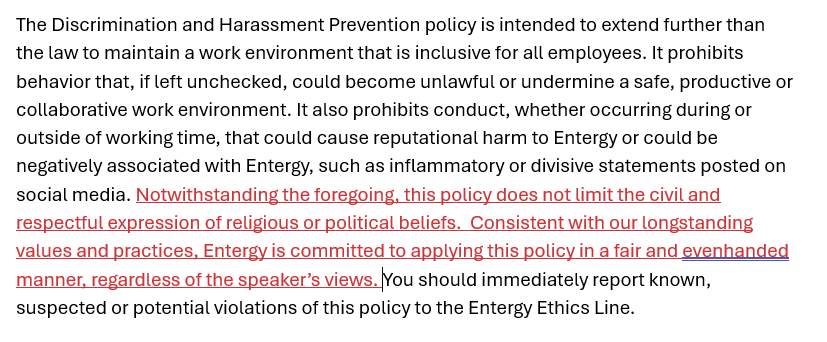
Inspire’s engagement with Entergy focused on how provisions addressing conduct perceived as “inflammatory” or “divisive” could be interpreted when applied to lawful religious or political expression outside of work. Following constructive dialogue, Entergy maintained its broader policy language but added an important clarification within its Discrimination and Harassment Prevention framework stating that, notwithstanding those provisions, the policy does not limit the civil and respectful expression of religious or political beliefs. The company also affirmed its commitment to applying the policy in a fair and even-handed manner regardless of the speaker’s views. This clarification provided meaningful guardrails around how the policy is interpreted and applied, and in light of these changes, Inspire withdrew its shareholder proposal.
Amendment to Entergy’s Code of Entegrity:
Mastercard — Policy Clarification and Multi-Year Engagement
Inspire filed a shareholder proposal at Mastercard focused on off-duty speech policies, encouraging the company to clarify how its Communications Policy protects lawful civic, religious, and political expression outside of work. Following constructive dialogue, Mastercard reaffirmed its commitment to protecting lawful off-duty expression and indicated that its policy revision cycle planned to include clarifying language reflecting this principle. With these assurances, Inspire withdrew its shareholder proposal.
Anticipated Amendment to Mastercard’s 2026 Communications Policy:
Mastercard respects each employee’s personal opinions and their right to engage in social, professional, religious and political dialogue outside of work, including on personal social media accounts. Employees should ensure that these activities are legal, reflect good judgement, do not disclose confidential or proprietary company information, and are conducted in line with commitments to existing company policies.
In parallel, our friends at The Heritage Foundation filed a separate shareholder proposal addressing related issues of neutrality and corporate policies, and Inspire also participated in engagement discussions on those topics as part of the broader dialogue with the company. Building on this work, Inspire has engaged with Mastercard over the past several years on related areas, including the structure of its Benevity platform, employee gift-matching eligibility, and the use of external designation frameworks that can introduce viewpoint discrimination into charitable giving programs. As part of this dialogue, we encouraged the company to avoid reliance on third-party filtering lists, including those that rely on the discredited Southern Poverty Law Center, and instead anchor eligibility in neutral, objective legal standards. As a result of our joint engagement, Mastercard previewed that it was already committed to updating its Benevity program by removing filters and moving to a neutral legal-eligibility standard, allowing employees to support any qualifying 501(c)(3) organization that is lawful and not on sanctions lists, without viewpoint-based restrictions. Consistent with the progress achieved through these discussions, The Heritage Foundation also withdrew its proposal.
Our coalition ally, Oklahoma State Treasurer Todd Russ, also filed a shareholder proposal focused on emerging risks related to AI-generated sexual exploitation, making him one of the few conservative state treasurers actively participating in the shareholder resolution process. The proposal encouraged Mastercard to strengthen safeguards around illicit or exploitative synthetic content, and the company agreed to update its existing standards on this topic to explicitly address digitally altered and AI-generated imagery. In light of the company’s commitments and the constructive dialogue, Treasurer Russ subsequently chose to withdraw the proposal. We are grateful for Treasurer Russ’s leadership in elevating this important issue and advancing shareholder-focused risk oversight.
Mastercard also confirmed with us that it did not participate in the most recent Human Rights Campaign Corporate Equality Index survey, a step consistent with maintaining neutrality on contested political issues and one on which we have engaged the company for several years.
Regions Financial — Clarifying Off-Duty Speech Protections
Inspire filed a shareholder proposal at Regions focused on off-duty speech policies, encouraging the company to assess risks associated with Code of Conduct language that could unintentionally chill lawful expression outside of work. Following constructive dialogue, Regions identified revisions to its Code of Conduct that are responsive to Inspire’s concerns with respect to employees’ lawful expression outside of work, which will be implemented in accordance with the company’s governance approval process.
Anticipated Amendment to Region’s Code of Conduct:
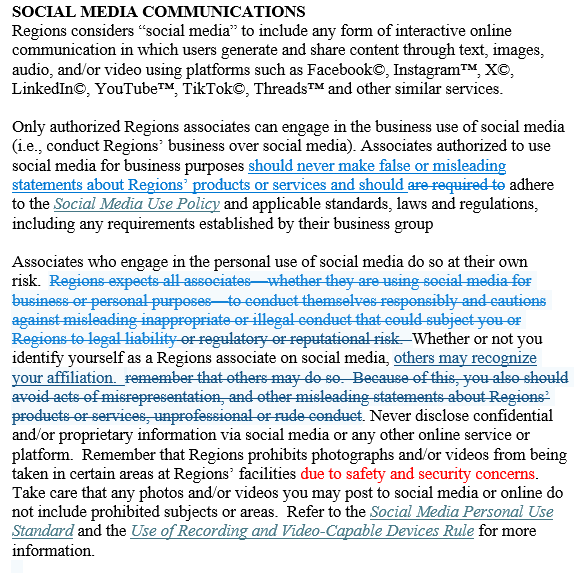
The Heritage Foundation filed a separate shareholder proposal addressing charitable neutrality and related policy language, and Inspire was also involved in the engagement on these topics. As part of this dialogue, Regions committed to revising existing language in its giving policy regarding religious nonprofits and improving clarity around support for faith-affiliated organizations.
As a result of these positive developments, Inspire withdrew its proposal. While not every change had been formally finalized at the time of withdrawal, the tone and substance of the engagement gave us confidence in the company’s direction. We have engaged constructively with Regions for several years and have found the company to be among the most responsive partners in our engagement program.
“We appreciate our ongoing engagement with Inspire Investing, which has provided an opportunity to reinforce our longstanding commitment to building a culture of fairness, respect, and inclusion for all of our stakeholders, regardless of their beliefs or viewpoints.” - Regions Bank
Tractor Supply — Narrowing Subjective Restrictions
Inspire filed a shareholder proposal at Tractor Supply focused on off-duty speech and social media provisions, encouraging the company to evaluate whether language in its Code of Business Ethics and Conduct regarding “inappropriate” postings could unintentionally chill lawful expression outside of work.
Following constructive engagement, the company agreed to revise this language to focus more specifically on clearly defined conduct such as discriminatory remarks, harassment, retaliation, threats, or other unlawful conduct, rather than broader subjective standards. This clarification reduced ambiguity while preserving the company’s ability to address genuinely harmful conduct.
With these revisions in place, Inspire withdrew its proposal.
Off-duty expression remains a priority area for Inspire’s engagement program. As expectations continue to evolve around workplace culture and civil liberties, companies will increasingly face questions about how their policies apply beyond the workplace.
As part of this broader engagement effort, Inspire is evaluating additional opportunities to encourage greater transparency around how corporate policies address lawful off-duty expression. For example, Inspire is planning to file a shareholder proposal at Oracle later this spring as part of this ongoing work. We believe this issue will continue gaining relevance as companies recognize that protecting lawful expression is fundamentally a governance and risk management issue with direct implications for employee morale, corporate culture, and long-term value creation.
Inspire is grateful for the thoughtful and constructive engagement of the teams at Mastercard, Regions Financial, Tractor Supply, and Entergy. We also appreciate the partnership of Alliance Defending Freedom, Bowyer Research, The Heritage Foundation, 1792 Exchange, and Treasurer Todd Russ.
Inspire’s corporate engagement approach is rooted in collaboration. The progress achieved demonstrates that companies and shareholders can work together to advance policies that uphold both professionalism and civil liberties.
ADF Legal: https://x.com/Jeremy_Tedesco/status/2014092914041790870

Tim Schwarzenberger, CFA is a Portfolio Manager and Director of Corporate Engagement for Inspire Investing. He previously served as Managing Director at Christian Brothers Investment Services (CBIS), where he was an integral member of the Investment Team responsible for implementing the firm’s strategy development, portfolio construction, and Catholic investing initiatives.


Across corporate America, companies are increasingly grappling with how to maintain respectful workplaces while also respecting employees’ civil liberties outside of work. Many corporate conduct policies include broad language discouraging “offensive,” “divisive,” or “inappropriate” speech, sometimes on personal social media accounts. While often well-intentioned, vague or subjective standards can create uncertainty about what employees can safely say in their private lives, particularly when it comes to expressing sincerely held religious or moral convictions.
At Inspire Investing, we believe companies can uphold professional standards while clearly respecting lawful religious, political, and civic expression. Respect for the free exercise of religion is a cornerstone of a free society, and workplace policies should not unintentionally pressure employees to set aside their beliefs when they step outside the office. Protecting off-duty expression is not only consistent with fundamental civil liberties, it is also a governance issue that affects legal risk, employee trust, and long-term corporate value.
Over the past year, Inspire has led a series of shareholder engagements encouraging companies to review and clarify policies that could unintentionally chill lawful expression. In several cases, constructive dialogue led to meaningful policy updates and the withdrawal of our proposals.
For investors, off-duty expression is not just a cultural issue. It is a governance and risk question. Policies that are vague or inconsistently applied can expose companies to legal challenges, reputational controversies, and employee-relations concerns. They can also create environments where employees feel hesitant to express their faith or participate fully in civic life, even on their own time.
From a governance perspective, clarity helps boards and management distinguish between conduct that genuinely harms the workplace and lawful expression that should be protected. Clear guardrails reduce uncertainty, improve workforce trust, and strengthen oversight while reinforcing the principle that respect for diverse viewpoints, including religious viewpoints, is compatible with a professional and inclusive workplace.
Former Levi’s Brand President Jennifer Sey resigned after publicly opposing school COVID lockdown policies in her personal capacity.
Mozilla co-founder Brendan Eich stepped down as CEO following backlash over a lawful political donation.
A Wisconsin ski resort has faced litigation after allegedly terminating an employee for posting Bible verses on personal social media.
Entergy — Written Guardrails for Religious and Political Expression
Inspire’s engagement with Entergy focused on how provisions addressing conduct perceived as “inflammatory” or “divisive” could be interpreted when applied to lawful religious or political expression outside of work. Following constructive dialogue, Entergy maintained its broader policy language but added an important clarification within its Discrimination and Harassment Prevention framework stating that, notwithstanding those provisions, the policy does not limit the civil and respectful expression of religious or political beliefs. The company also affirmed its commitment to applying the policy in a fair and even-handed manner regardless of the speaker’s views. This clarification provided meaningful guardrails around how the policy is interpreted and applied, and in light of these changes, Inspire withdrew its shareholder proposal.
Amendment to Entergy’s Code of Entegrity:
Mastercard — Policy Clarification and Multi-Year Engagement
Inspire filed a shareholder proposal at Mastercard focused on off-duty speech policies, encouraging the company to clarify how its Communications Policy protects lawful civic, religious, and political expression outside of work. Following constructive dialogue, Mastercard reaffirmed its commitment to protecting lawful off-duty expression and indicated that its policy revision cycle planned to include clarifying language reflecting this principle. With these assurances, Inspire withdrew its shareholder proposal.
Anticipated Amendment to Mastercard’s 2026 Communications Policy:
Mastercard respects each employee’s personal opinions and their right to engage in social, professional, religious and political dialogue outside of work, including on personal social media accounts. Employees should ensure that these activities are legal, reflect good judgement, do not disclose confidential or proprietary company information, and are conducted in line with commitments to existing company policies.
In parallel, our friends at The Heritage Foundation filed a separate shareholder proposal addressing related issues of neutrality and corporate policies, and Inspire also participated in engagement discussions on those topics as part of the broader dialogue with the company. Building on this work, Inspire has engaged with Mastercard over the past several years on related areas, including the structure of its Benevity platform, employee gift-matching eligibility, and the use of external designation frameworks that can introduce viewpoint discrimination into charitable giving programs. As part of this dialogue, we encouraged the company to avoid reliance on third-party filtering lists, including those that rely on the discredited Southern Poverty Law Center, and instead anchor eligibility in neutral, objective legal standards. As a result of our joint engagement, Mastercard previewed that it was already committed to updating its Benevity program by removing filters and moving to a neutral legal-eligibility standard, allowing employees to support any qualifying 501(c)(3) organization that is lawful and not on sanctions lists, without viewpoint-based restrictions. Consistent with the progress achieved through these discussions, The Heritage Foundation also withdrew its proposal.
Our coalition ally, Oklahoma State Treasurer Todd Russ, also filed a shareholder proposal focused on emerging risks related to AI-generated sexual exploitation, making him one of the few conservative state treasurers actively participating in the shareholder resolution process. The proposal encouraged Mastercard to strengthen safeguards around illicit or exploitative synthetic content, and the company agreed to update its existing standards on this topic to explicitly address digitally altered and AI-generated imagery. In light of the company’s commitments and the constructive dialogue, Treasurer Russ subsequently chose to withdraw the proposal. We are grateful for Treasurer Russ’s leadership in elevating this important issue and advancing shareholder-focused risk oversight.
Mastercard also confirmed with us that it did not participate in the most recent Human Rights Campaign Corporate Equality Index survey, a step consistent with maintaining neutrality on contested political issues and one on which we have engaged the company for several years.
Regions Financial — Clarifying Off-Duty Speech Protections
Inspire filed a shareholder proposal at Regions focused on off-duty speech policies, encouraging the company to assess risks associated with Code of Conduct language that could unintentionally chill lawful expression outside of work. Following constructive dialogue, Regions identified revisions to its Code of Conduct that are responsive to Inspire’s concerns with respect to employees’ lawful expression outside of work, which will be implemented in accordance with the company’s governance approval process.
Anticipated Amendment to Region’s Code of Conduct:
The Heritage Foundation filed a separate shareholder proposal addressing charitable neutrality and related policy language, and Inspire was also involved in the engagement on these topics. As part of this dialogue, Regions committed to revising existing language in its giving policy regarding religious nonprofits and improving clarity around support for faith-affiliated organizations.
As a result of these positive developments, Inspire withdrew its proposal. While not every change had been formally finalized at the time of withdrawal, the tone and substance of the engagement gave us confidence in the company’s direction. We have engaged constructively with Regions for several years and have found the company to be among the most responsive partners in our engagement program.
“We appreciate our ongoing engagement with Inspire Investing, which has provided an opportunity to reinforce our longstanding commitment to building a culture of fairness, respect, and inclusion for all of our stakeholders, regardless of their beliefs or viewpoints.” - Regions Bank
Tractor Supply — Narrowing Subjective Restrictions
Inspire filed a shareholder proposal at Tractor Supply focused on off-duty speech and social media provisions, encouraging the company to evaluate whether language in its Code of Business Ethics and Conduct regarding “inappropriate” postings could unintentionally chill lawful expression outside of work.
Following constructive engagement, the company agreed to revise this language to focus more specifically on clearly defined conduct such as discriminatory remarks, harassment, retaliation, threats, or other unlawful conduct, rather than broader subjective standards. This clarification reduced ambiguity while preserving the company’s ability to address genuinely harmful conduct.
With these revisions in place, Inspire withdrew its proposal.
Off-duty expression remains a priority area for Inspire’s engagement program. As expectations continue to evolve around workplace culture and civil liberties, companies will increasingly face questions about how their policies apply beyond the workplace.
As part of this broader engagement effort, Inspire is evaluating additional opportunities to encourage greater transparency around how corporate policies address lawful off-duty expression. For example, Inspire is planning to file a shareholder proposal at Oracle later this spring as part of this ongoing work. We believe this issue will continue gaining relevance as companies recognize that protecting lawful expression is fundamentally a governance and risk management issue with direct implications for employee morale, corporate culture, and long-term value creation.
Inspire is grateful for the thoughtful and constructive engagement of the teams at Mastercard, Regions Financial, Tractor Supply, and Entergy. We also appreciate the partnership of Alliance Defending Freedom, Bowyer Research, The Heritage Foundation, 1792 Exchange, and Treasurer Todd Russ.
Inspire’s corporate engagement approach is rooted in collaboration. The progress achieved demonstrates that companies and shareholders can work together to advance policies that uphold both professionalism and civil liberties.
ADF Legal: https://x.com/Jeremy_Tedesco/status/2014092914041790870



.jpg)