.jpg)
Employee Resource Groups (ERGs) have become a common feature of Corporate America. Many companies sponsor groups organized around various employee communities, yet employees of faith have often not been afforded the same opportunities.
Over the past several proxy seasons, Inspire Investing has engaged public companies on a straightforward principle: if companies choose to sponsor employee resource groups based on protected characteristics, religion should be treated no differently.
Inspire has not taken the position that every company should establish a faith-based employee resource group. Rather, we have encouraged companies to pursue one of two approaches: either provide employees of faith the same opportunity to organize and participate as other employee communities or move away from identity-based employee resource groups altogether. Either approach addresses our concern.
The Equal Employment Opportunity Commission (EEOC) has provided some guidance on this matter, stating that limiting membership in employer-sponsored ERGs based on protected characteristics may constitute unlawful segregation under Title VII and that employees of all backgrounds should have equal access to workplace networks. Although the EEOC has not specifically addressed whether companies may prohibit Christian or other religious ERGs from forming, its guidance, together with our discussions with the agency, suggests that companies would be well advised to treat protected characteristics consistently, including by avoiding support for employee groups organized around some protected characteristics while excluding religion, which is itself protected under Title VII of the Civil Rights Act.
At its core, this issue is not about expanding employee resource groups. It has always been about equal treatment.
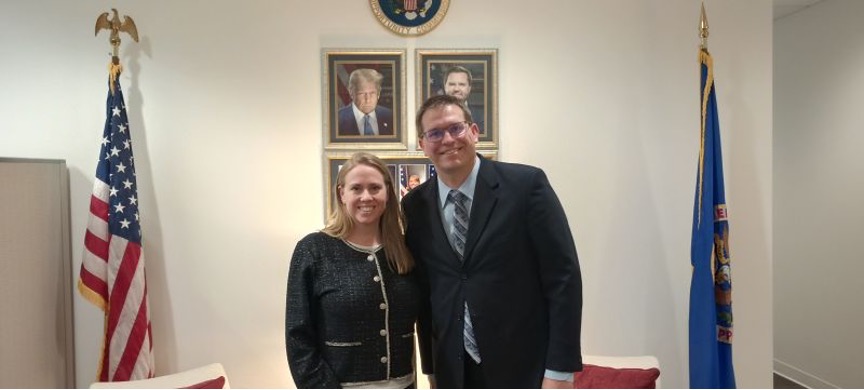
Inspire Investing has engaged in shareholder advocacy focused on equal treatment of employees of faith in Corporate America.
Through constructive shareholder engagement, companies across multiple industries have taken meaningful steps to strengthen equal treatment for employees of faith. While not every engagement produced the same outcome, companies have established faith-based employee resource groups, clarified that employees are free to organize them, and, in some cases, moved away from organizational support for identity-based employee resource groups altogether.
This progress has been achieved through shareholder proposals, direct engagement with management teams, annual meeting presentations, and ongoing dialogue with public companies. The following pages highlight many of the meaningful outcomes from those engagements.
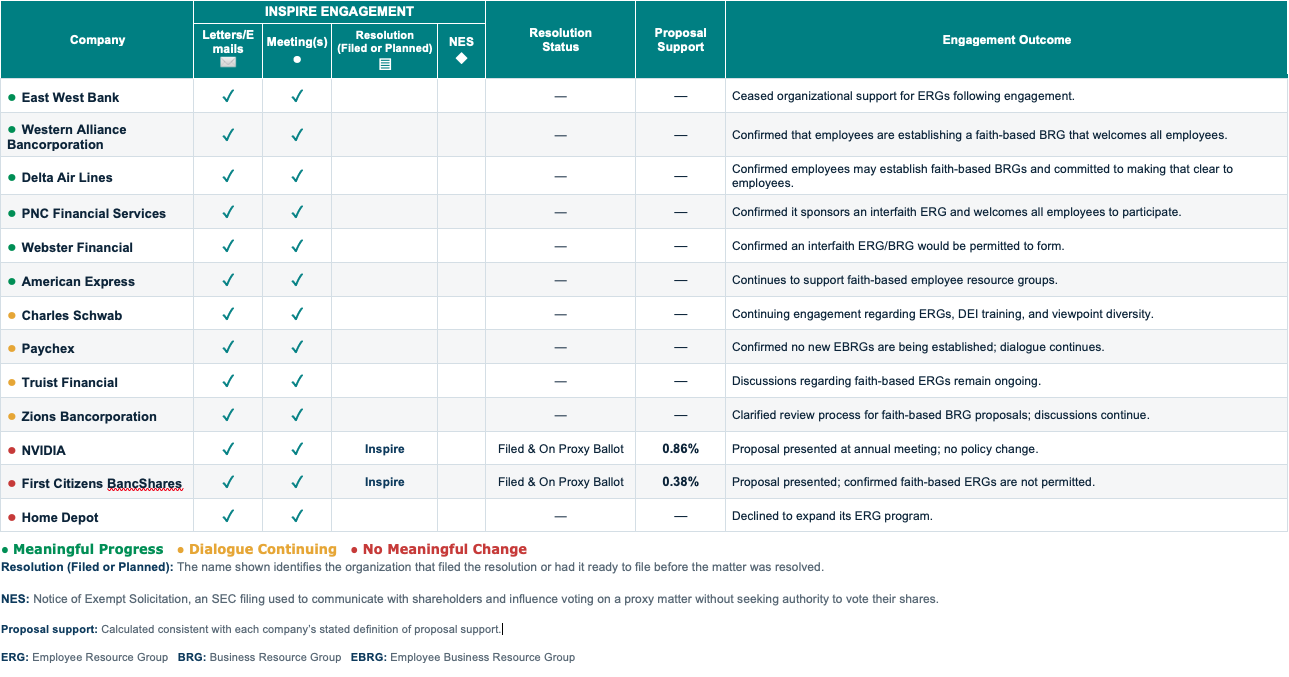
The voting results reveal a troubling disconnect. Our proposals at NVIDIA and First Citizens received just 0.86% and 0.38% support, respectively. If Christian institutions and advisors believe employees of faith deserve equal treatment, they should ensure their shares are voted accordingly. Instead, support for even basic evaluation and transparency remained below 1%. Too many Christian investors remain asleep at the wheel.
Until investors begin taking proxy voting seriously, proposals grounded in Christian principles will continue to receive low levels of shareholder support. We hope more Christians will begin using investment products whose proxy voting aligns with their deeply held beliefs. Encouragingly, things are beginning to move in the right direction as faithfully Christian proxy voting guidelines, including those developed by The Catholic University of America, are increasingly utilized and recommended by investors, advisors, and investment consultants.
Through years of constructive shareholder engagement, Inspire has observed meaningful developments for employees of faith across Corporate America. Not every engagement resulted in the same type of outcome. Some companies established faith-based employee resource groups. Others clarified that employees of faith may organize them under existing policies. Still others moved away from organizational support for identity-based employee resource groups altogether. Taken together, these outcomes demonstrate that companies are increasingly recognizing the importance of treating religion consistently with other protected characteristics and strengthening equal treatment for employees of faith.
East West Bank was one of the most constructive and collaborative companies we engaged during this proxy season. The company confirmed that it has ceased organizational support for employee resource groups, adopting a more viewpoint-neutral approach that treats all employees consistently rather than organizing support around particular identity groups.
Our discussions also extended beyond employee resource groups to include religious discrimination, debanking, and other issues affecting employees and customers of faith. The company's willingness to engage thoughtfully across these issues reflects a genuine commitment to constructive shareholder dialogue.
Based on the significant progress made during these discussions, Inspire elected not to file a shareholder proposal.
Inspire's engagement with Western Alliance builds on a constructive, multi-year dialogue. During the prior year, the company updated its Corporate Responsibility Report to strengthen its commitments related to employee development and its anti-harassment and non-discrimination policies.
This year, our discussions included account access policies and equal treatment for employees of faith. Based on the company's constructive engagement and the progress made during these discussions, Inspire elected not to submit a shareholder proposal.
Western Alliance also confirmed that it is in the process of establishing a faith-based employee resource group, an outcome Inspire has encouraged at the company.
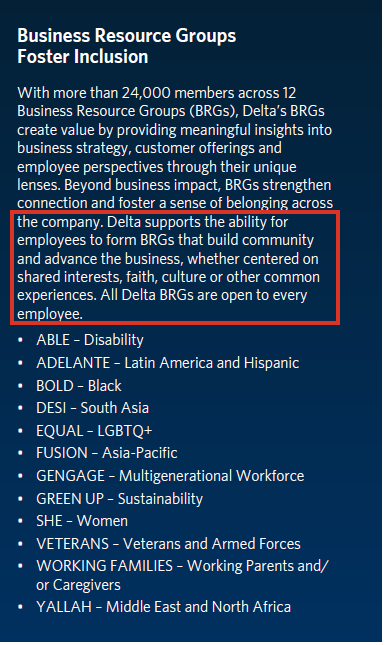
Delta was one of the most thoughtful and constructive companies we engaged throughout this process. The company confirmed that employees may establish faith-based Business Resource Groups under its existing framework and committed to making that clear to employees.
Delta's commitment to equal treatment was perhaps best reflected in one statement during our engagement:
"We need to make it really clear to our employees they can have a Christian BRG... this would show the world that Delta really does welcome all."
— Delta Air Lines
Excerpt from Updated Delta Difference Report:
PNC continues to serve as a positive example by sponsoring an interfaith Employee Business Resource Group and welcoming all employees to participate in every employee resource group. We appreciate the company's commitment to fostering an environment where employees of faith are included alongside other employee communities.
Webster confirmed that although it does not currently sponsor a religious business resource group, an interfaith business resource group would be permitted if employees chose to organize one. This issue had previously been raised through an Inspire shareholder proposal in 2024, and we appreciate the company's willingness to confirm this approach during our engagement. Based on the company's constructive engagement and the progress made during our discussions, Inspire elected not to file a shareholder proposal.
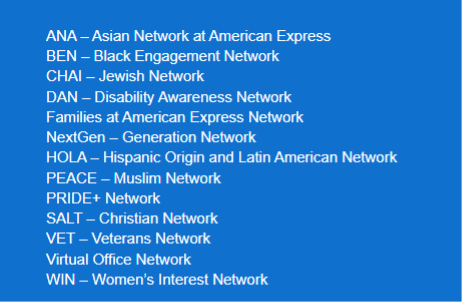
American Express has long recognized employees of faith by supporting faith-based colleague networks alongside its other employee communities. The company's Christian, Jewish, and Muslim networks demonstrate that employees of faith can be included within an employee resource group framework alongside other protected characteristics.
Not every engagement results in an immediate policy change. In several cases, companies were willing to engage constructively, clarify existing policies, or continue discussions regarding equal treatment for employees of faith. While these engagements have not yet resulted in the policy changes Inspire encouraged, they represent meaningful progress and provide a foundation for future discussions.
Although Inspire’s primary engagement with Charles Schwab focused on healthcare benefits, we also discussed employee resource groups, DEI-related training, workplace policies affecting employees of faith, and viewpoint diversity. Schwab does not currently sponsor a faith-based employee resource group and Inspire continues to encourage the company to provide employees of faith the same opportunity afforded to other employee communities. Schwab agreed to continue engaging with Inspire on these issues.
During our engagement, Paychex explained that it is not establishing any new Employee Business Resource Groups (EBRGs) at this time, including a faith-based employee resource group. The company nevertheless agreed to continue engaging with Inspire outside the shareholder proposal process.
Truist does not currently sponsor a faith-based employee resource group, and discussions regarding equal treatment for employees of faith remain ongoing. We appreciate the company's willingness to continue engaging with Inspire on this important issue, which was previously raised through a shareholder proposal Inspire filed and withdrew in 2024.
Zions confirmed that participation in its existing Business Resource Groups is open to all employees and that any proposal to establish a faith-based Business Resource Group would receive the same level of review and consideration as any other proposal. We appreciate this clarification and will continue encouraging the company to provide employees with greater certainty that faith-based groups are welcomed. This issue was also the subject of a previous Inspire shareholder proposal.
Not every company chose to make the changes we encouraged. Nevertheless, we appreciate the opportunity to engage these companies, present our concerns directly to shareholders and management where appropriate, and continue advancing the conversation about equal treatment for employees of faith in Corporate America.
As the world's largest publicly traded company (as of 9/15/26), NVIDIA's policies influence not only its own workforce but often set an example for Corporate America more broadly.
Inspire filed a shareholder proposal requesting that NVIDIA evaluate the risks associated with supporting employee resource groups for certain employee communities while excluding employees of faith. The issue is not whether companies should sponsor employee resource groups, but whether religion should be treated consistently with other protected characteristics.
At NVIDIA's annual meeting, Inspire explained why equal treatment for employees of faith is not only an important workplace issue, but also a significant corporate governance issue in light of Title VII, recent Supreme Court decisions, and the evolving legal landscape.
NVIDIA CEO Jensen Huang has stated that the company seeks to "be empathetic to the experience of all and act to make NVIDIA a place of opportunities." That is an admirable goal. We believe ensuring employees of faith are afforded the same opportunities as other employee communities would further advance that vision.
Watch Inspire's presentation to NVIDIA shareholders:
Inspire filed and presented a shareholder proposal encouraging equal treatment for employees of faith.
During our engagement, First Citizens confirmed that it does not permit employees to establish faith-based employee resource groups, despite sponsoring employee resource groups organized around other protected characteristics. That confirmation reinforced the importance of the proposal presented to shareholders and highlighted the unequal treatment of employees of faith under the company's current policy.
While the company ultimately declined to adopt the requested changes, Inspire will continue encouraging First Citizens to treat religion consistently with other protected characteristics.
Watch Inspire's presentation to First Citizens shareholders:
Home Depot confirmed that it currently sponsors nine employee resource groups but does not permit employees to establish a faith-based employee resource group. While the company maintained its existing approach, Inspire continues to encourage Home Depot to ensure that employees of faith receive equal treatment under its employee resource group framework.
We appreciate the many companies that engaged thoughtfully throughout this process. Whether by establishing a faith-based employee resource group, clarifying that employees of faith may organize one, confirming that religious groups are welcome under existing policies, or adopting a more viewpoint-neutral approach, these organizations demonstrated that constructive shareholder engagement can produce meaningful results.
We thank East West Bank, Western Alliance Bancorporation, Delta Air Lines, PNC Financial Services, Webster Financial, and American Express for their willingness to engage and make meaningful progress on this important issue.
We also thank our coalition partners, Alliance Defending Freedom and Bowyer Research, for their collaboration and partnership throughout these engagements.
We will continue engaging companies on this important issue in the years ahead. We believe these engagements provide a constructive model for Corporate America, and we look forward to building on the momentum already achieved through respectful shareholder dialogue.
It is time for Christians to be brought up from the catacombs in Corporate America.

Tim Schwarzenberger, CFA is a Portfolio Manager and Director of Corporate Engagement for Inspire Investing. He previously served as Managing Director at Christian Brothers Investment Services (CBIS), where he was an integral member of the Investment Team responsible for implementing the firm’s strategy development, portfolio construction, and Catholic investing initiatives.


Employee Resource Groups (ERGs) have become a common feature of Corporate America. Many companies sponsor groups organized around various employee communities, yet employees of faith have often not been afforded the same opportunities.
Over the past several proxy seasons, Inspire Investing has engaged public companies on a straightforward principle: if companies choose to sponsor employee resource groups based on protected characteristics, religion should be treated no differently.
Inspire has not taken the position that every company should establish a faith-based employee resource group. Rather, we have encouraged companies to pursue one of two approaches: either provide employees of faith the same opportunity to organize and participate as other employee communities or move away from identity-based employee resource groups altogether. Either approach addresses our concern.
The Equal Employment Opportunity Commission (EEOC) has provided some guidance on this matter, stating that limiting membership in employer-sponsored ERGs based on protected characteristics may constitute unlawful segregation under Title VII and that employees of all backgrounds should have equal access to workplace networks. Although the EEOC has not specifically addressed whether companies may prohibit Christian or other religious ERGs from forming, its guidance, together with our discussions with the agency, suggests that companies would be well advised to treat protected characteristics consistently, including by avoiding support for employee groups organized around some protected characteristics while excluding religion, which is itself protected under Title VII of the Civil Rights Act.
At its core, this issue is not about expanding employee resource groups. It has always been about equal treatment.
Inspire Investing has engaged in shareholder advocacy focused on equal treatment of employees of faith in Corporate America.
Through constructive shareholder engagement, companies across multiple industries have taken meaningful steps to strengthen equal treatment for employees of faith. While not every engagement produced the same outcome, companies have established faith-based employee resource groups, clarified that employees are free to organize them, and, in some cases, moved away from organizational support for identity-based employee resource groups altogether.
This progress has been achieved through shareholder proposals, direct engagement with management teams, annual meeting presentations, and ongoing dialogue with public companies. The following pages highlight many of the meaningful outcomes from those engagements.
The voting results reveal a troubling disconnect. Our proposals at NVIDIA and First Citizens received just 0.86% and 0.38% support, respectively. If Christian institutions and advisors believe employees of faith deserve equal treatment, they should ensure their shares are voted accordingly. Instead, support for even basic evaluation and transparency remained below 1%. Too many Christian investors remain asleep at the wheel.
Until investors begin taking proxy voting seriously, proposals grounded in Christian principles will continue to receive low levels of shareholder support. We hope more Christians will begin using investment products whose proxy voting aligns with their deeply held beliefs. Encouragingly, things are beginning to move in the right direction as faithfully Christian proxy voting guidelines, including those developed by The Catholic University of America, are increasingly utilized and recommended by investors, advisors, and investment consultants.
Through years of constructive shareholder engagement, Inspire has observed meaningful developments for employees of faith across Corporate America. Not every engagement resulted in the same type of outcome. Some companies established faith-based employee resource groups. Others clarified that employees of faith may organize them under existing policies. Still others moved away from organizational support for identity-based employee resource groups altogether. Taken together, these outcomes demonstrate that companies are increasingly recognizing the importance of treating religion consistently with other protected characteristics and strengthening equal treatment for employees of faith.
East West Bank was one of the most constructive and collaborative companies we engaged during this proxy season. The company confirmed that it has ceased organizational support for employee resource groups, adopting a more viewpoint-neutral approach that treats all employees consistently rather than organizing support around particular identity groups.
Our discussions also extended beyond employee resource groups to include religious discrimination, debanking, and other issues affecting employees and customers of faith. The company's willingness to engage thoughtfully across these issues reflects a genuine commitment to constructive shareholder dialogue.
Based on the significant progress made during these discussions, Inspire elected not to file a shareholder proposal.
Inspire's engagement with Western Alliance builds on a constructive, multi-year dialogue. During the prior year, the company updated its Corporate Responsibility Report to strengthen its commitments related to employee development and its anti-harassment and non-discrimination policies.
This year, our discussions included account access policies and equal treatment for employees of faith. Based on the company's constructive engagement and the progress made during these discussions, Inspire elected not to submit a shareholder proposal.
Western Alliance also confirmed that it is in the process of establishing a faith-based employee resource group, an outcome Inspire has encouraged at the company.
Delta was one of the most thoughtful and constructive companies we engaged throughout this process. The company confirmed that employees may establish faith-based Business Resource Groups under its existing framework and committed to making that clear to employees.
Delta's commitment to equal treatment was perhaps best reflected in one statement during our engagement:
"We need to make it really clear to our employees they can have a Christian BRG... this would show the world that Delta really does welcome all."
— Delta Air Lines
Excerpt from Updated Delta Difference Report:
PNC continues to serve as a positive example by sponsoring an interfaith Employee Business Resource Group and welcoming all employees to participate in every employee resource group. We appreciate the company's commitment to fostering an environment where employees of faith are included alongside other employee communities.
Webster confirmed that although it does not currently sponsor a religious business resource group, an interfaith business resource group would be permitted if employees chose to organize one. This issue had previously been raised through an Inspire shareholder proposal in 2024, and we appreciate the company's willingness to confirm this approach during our engagement. Based on the company's constructive engagement and the progress made during our discussions, Inspire elected not to file a shareholder proposal.
American Express has long recognized employees of faith by supporting faith-based colleague networks alongside its other employee communities. The company's Christian, Jewish, and Muslim networks demonstrate that employees of faith can be included within an employee resource group framework alongside other protected characteristics.
Not every engagement results in an immediate policy change. In several cases, companies were willing to engage constructively, clarify existing policies, or continue discussions regarding equal treatment for employees of faith. While these engagements have not yet resulted in the policy changes Inspire encouraged, they represent meaningful progress and provide a foundation for future discussions.
Although Inspire’s primary engagement with Charles Schwab focused on healthcare benefits, we also discussed employee resource groups, DEI-related training, workplace policies affecting employees of faith, and viewpoint diversity. Schwab does not currently sponsor a faith-based employee resource group and Inspire continues to encourage the company to provide employees of faith the same opportunity afforded to other employee communities. Schwab agreed to continue engaging with Inspire on these issues.
During our engagement, Paychex explained that it is not establishing any new Employee Business Resource Groups (EBRGs) at this time, including a faith-based employee resource group. The company nevertheless agreed to continue engaging with Inspire outside the shareholder proposal process.
Truist does not currently sponsor a faith-based employee resource group, and discussions regarding equal treatment for employees of faith remain ongoing. We appreciate the company's willingness to continue engaging with Inspire on this important issue, which was previously raised through a shareholder proposal Inspire filed and withdrew in 2024.
Zions confirmed that participation in its existing Business Resource Groups is open to all employees and that any proposal to establish a faith-based Business Resource Group would receive the same level of review and consideration as any other proposal. We appreciate this clarification and will continue encouraging the company to provide employees with greater certainty that faith-based groups are welcomed. This issue was also the subject of a previous Inspire shareholder proposal.
Not every company chose to make the changes we encouraged. Nevertheless, we appreciate the opportunity to engage these companies, present our concerns directly to shareholders and management where appropriate, and continue advancing the conversation about equal treatment for employees of faith in Corporate America.
As the world's largest publicly traded company (as of 9/15/26), NVIDIA's policies influence not only its own workforce but often set an example for Corporate America more broadly.
Inspire filed a shareholder proposal requesting that NVIDIA evaluate the risks associated with supporting employee resource groups for certain employee communities while excluding employees of faith. The issue is not whether companies should sponsor employee resource groups, but whether religion should be treated consistently with other protected characteristics.
At NVIDIA's annual meeting, Inspire explained why equal treatment for employees of faith is not only an important workplace issue, but also a significant corporate governance issue in light of Title VII, recent Supreme Court decisions, and the evolving legal landscape.
NVIDIA CEO Jensen Huang has stated that the company seeks to "be empathetic to the experience of all and act to make NVIDIA a place of opportunities." That is an admirable goal. We believe ensuring employees of faith are afforded the same opportunities as other employee communities would further advance that vision.
Watch Inspire's presentation to NVIDIA shareholders:
Inspire filed and presented a shareholder proposal encouraging equal treatment for employees of faith.
During our engagement, First Citizens confirmed that it does not permit employees to establish faith-based employee resource groups, despite sponsoring employee resource groups organized around other protected characteristics. That confirmation reinforced the importance of the proposal presented to shareholders and highlighted the unequal treatment of employees of faith under the company's current policy.
While the company ultimately declined to adopt the requested changes, Inspire will continue encouraging First Citizens to treat religion consistently with other protected characteristics.
Watch Inspire's presentation to First Citizens shareholders:
Home Depot confirmed that it currently sponsors nine employee resource groups but does not permit employees to establish a faith-based employee resource group. While the company maintained its existing approach, Inspire continues to encourage Home Depot to ensure that employees of faith receive equal treatment under its employee resource group framework.
We appreciate the many companies that engaged thoughtfully throughout this process. Whether by establishing a faith-based employee resource group, clarifying that employees of faith may organize one, confirming that religious groups are welcome under existing policies, or adopting a more viewpoint-neutral approach, these organizations demonstrated that constructive shareholder engagement can produce meaningful results.
We thank East West Bank, Western Alliance Bancorporation, Delta Air Lines, PNC Financial Services, Webster Financial, and American Express for their willingness to engage and make meaningful progress on this important issue.
We also thank our coalition partners, Alliance Defending Freedom and Bowyer Research, for their collaboration and partnership throughout these engagements.
We will continue engaging companies on this important issue in the years ahead. We believe these engagements provide a constructive model for Corporate America, and we look forward to building on the momentum already achieved through respectful shareholder dialogue.
It is time for Christians to be brought up from the catacombs in Corporate America.